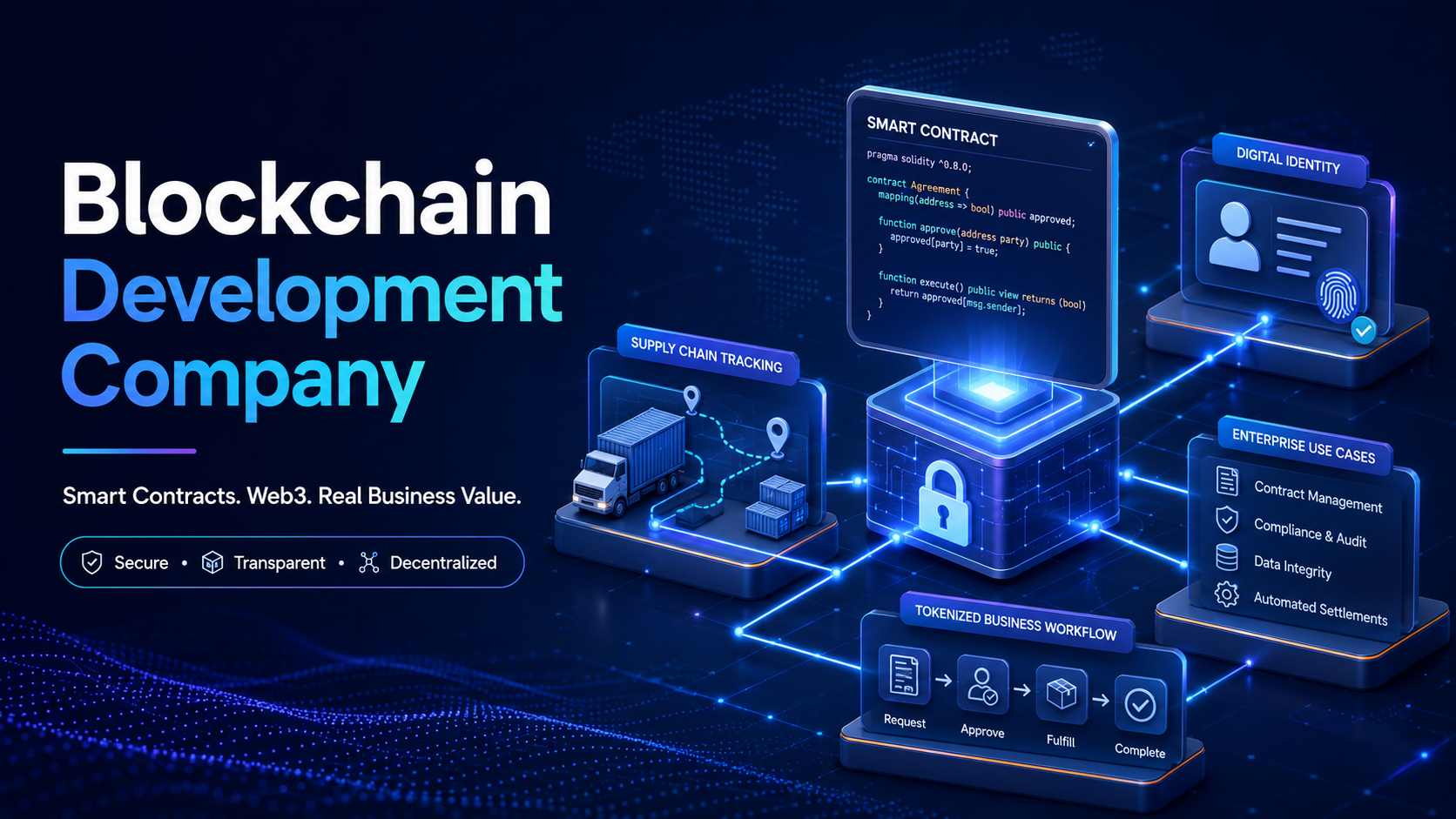
Blockchain has spent the last several years swinging between "the future of everything" and "an overhyped buzzword," and the truth sits somewhere in between. For most businesses, a traditional database is still the right tool. But for a specific set of use cases — transparent transactions, tamper-proof records, decentralized ownership — blockchain solves problems no other technology can. A capable blockchain development company should be honest about which category your project actually falls into.
When Blockchain Actually Makes Sense
- Supply chain tracking, where every party needs to verify a product's origin and movement without trusting a single central authority
- Smart contracts, where payments or agreements need to execute automatically once predefined conditions are met, without manual processing
- Tokenization and digital assets, where ownership needs to be provably unique and transferable
- Decentralized applications (dApps), where the whole point is removing a central point of control or failure
When It Probably Doesn't
If your core need is simply "a secure database" or "fast transaction processing," traditional infrastructure is almost always faster to build, cheaper to maintain, and easier to scale. Part of working with an experienced blockchain development company is getting an honest answer here — not being sold blockchain because it sounds innovative.
What Smart Contract Development Actually Involves
Smart contracts are self-executing code deployed on a blockchain — but unlike regular software, bugs in deployed smart contracts can be extremely costly or impossible to patch quickly. This makes rigorous testing and security auditing non-negotiable, not optional. A serious development partner treats smart contract testing with the same weight as financial software testing, because in many cases, that's exactly what it is.
Choosing the Right Blockchain Platform
Different blockchains suit different needs:
- Ethereum — the most established ecosystem, ideal for projects that need broad compatibility and a mature developer community
- Solana — built for high-speed, low-cost transactions, often used for applications needing fast throughput
- Hyperledger — designed for permissioned, enterprise blockchain use cases like supply chain or private consortiums
An experienced team should recommend a platform based on your project's actual requirements — transaction speed, cost, and whether the network needs to be public or permissioned — not default to whichever one is trending.
What to Look for in a Web3 Development Partner
- Security-first development — smart contract audits and testing should be standard practice, not an optional add-on
- Real delivered projects — ask to see live contracts or dApps, not just conceptual case studies
- Clear technology reasoning — they should explain why a specific blockchain and architecture fits your use case
- Full-stack capability — most blockchain products still need a traditional frontend, backend, and database working alongside the blockchain layer
Jayshree Technosoft's Blockchain Development Practice
Jayshree Technosoft builds decentralized applications and smart contracts using Solidity, Rust, Ethereum, Solana, Hyperledger, and Web3.js, as part of a broader engineering practice that also covers web, mobile, and cloud infrastructure. That combination matters, because most blockchain products still need traditional development skills to build the interface, backend, and integrations surrounding the blockchain layer itself.
Explore Whether Blockchain Fits Your Project
If you're evaluating whether blockchain is the right fit for your business — or you already know it is and need it built properly — talk to Jayshree Technosoft about your project.
Recent Articles

Best CRM Software in Jaipur for Kirana Stores: How POS Billing CRM Simplifies Daily Operations

How DataBridgeCRM's Real Estate CRM Works, From First Enquiry to Closed Deal

How LawDesk & CADesk Work for Lawyers and Chartered Accountants
