Every business has a version of this conversation eventually. The billing computer dies during the busiest week. The internet goes down for two days. Someone deletes something important. The office floods.
What determines whether it costs hours or weeks is entirely decided beforehand.
Jayshree Technosoft LLP has helped businesses through and after these situations since 2009.
The One-Page Plan
Businesses hear "business continuity" and imagine a formal document nobody reads. What actually helps is one page answering four questions:
What are the three things that must keep working? For most businesses: taking orders, billing customers, and communicating. Not everything is critical — being clear about what is prevents wasted effort protecting things that aren't.
What breaks them? Power, internet, a specific computer, a specific person, or your software provider.
What do we do in each case? Written down, in plain language, so someone other than you can act on it.
Who does what? Names, not roles. And their phone numbers.
An afternoon to write. The value appears on the day you're unreachable and someone else has to handle it.
The Failures That Actually Happen
Not dramatic ones. These:
Hardware death. The computer holding everything stops. If your data lives on one machine, this is an existential event rather than an inconvenience.
Internet outage. Increasingly serious as businesses move online. If billing, payments, and communication all depend on connectivity, a two-day outage is a two-day closure.
Accidental deletion. More common than any attack. Someone deletes a folder, overwrites a file, or clears the wrong records.
Ransomware. Usually arriving through an unpatched machine or a downloaded file. Recovery depends entirely on whether you have clean backups.
Key person unavailable. The one who knows the passwords, the process, or where things are. Illness, family emergency, or resignation — the effect is the same.
Provider failure. Your software or hosting provider has an outage, or in the worst case shuts down.
Backups: The Part That Actually Saves You
Almost every business believes it has backups. Considerably fewer have working ones, and the difference is only discovered at the worst possible moment.
The test: restore something today, while you watch. If nobody can demonstrate this within an hour, you don't have backups — you have an assumption.
The principle worth following: three copies of your data, on two different types of storage, with one kept somewhere else. A backup on the same computer as the original is not a backup. A backup on a drive in the same office survives a hardware failure and not a fire or a theft.
Also verify: how often backups run, how far back they go, and who confirms they're succeeding. Backup systems fail silently, which is why someone has to check rather than assume.
And for ransomware specifically: a backup that's permanently connected can be encrypted along with everything else. At least one copy should be offline or separately protected.
Keeping the Critical Three Running
Taking orders. If your system is down, can staff record orders on paper and enter them later? Sounds primitive and it keeps the business trading. The plan should say where the pad is.
Billing. This is why offline capability in billing software matters so much in Indian conditions. Ask whether yours works without internet — and test it rather than trusting the answer. A system that stops billing during a power or connectivity failure stops being trusted permanently.
Communication. If your business email is down, how do customers reach you? A phone number that's monitored, and a way to update customers — social media or WhatsApp — covers most situations.
Reducing Single Points of Failure
Data in one place. Cloud systems remove this by default, which is one of their strongest practical arguments for small businesses. If your data lives only on office machines, that's a concentrated risk.
One person who knows things. Passwords in a shared, controlled place rather than one person's memory. Processes written down. At least two people who can do each critical task.
One internet connection, where downtime genuinely costs money. A backup connection or mobile failover is cheaper than the losses.
One provider for everything. Convenient, and it means a single provider's outage stops your whole business. Worth being aware of rather than necessarily avoiding.
What to Do in the First Hour
Written in advance, because judgment is worse under pressure:
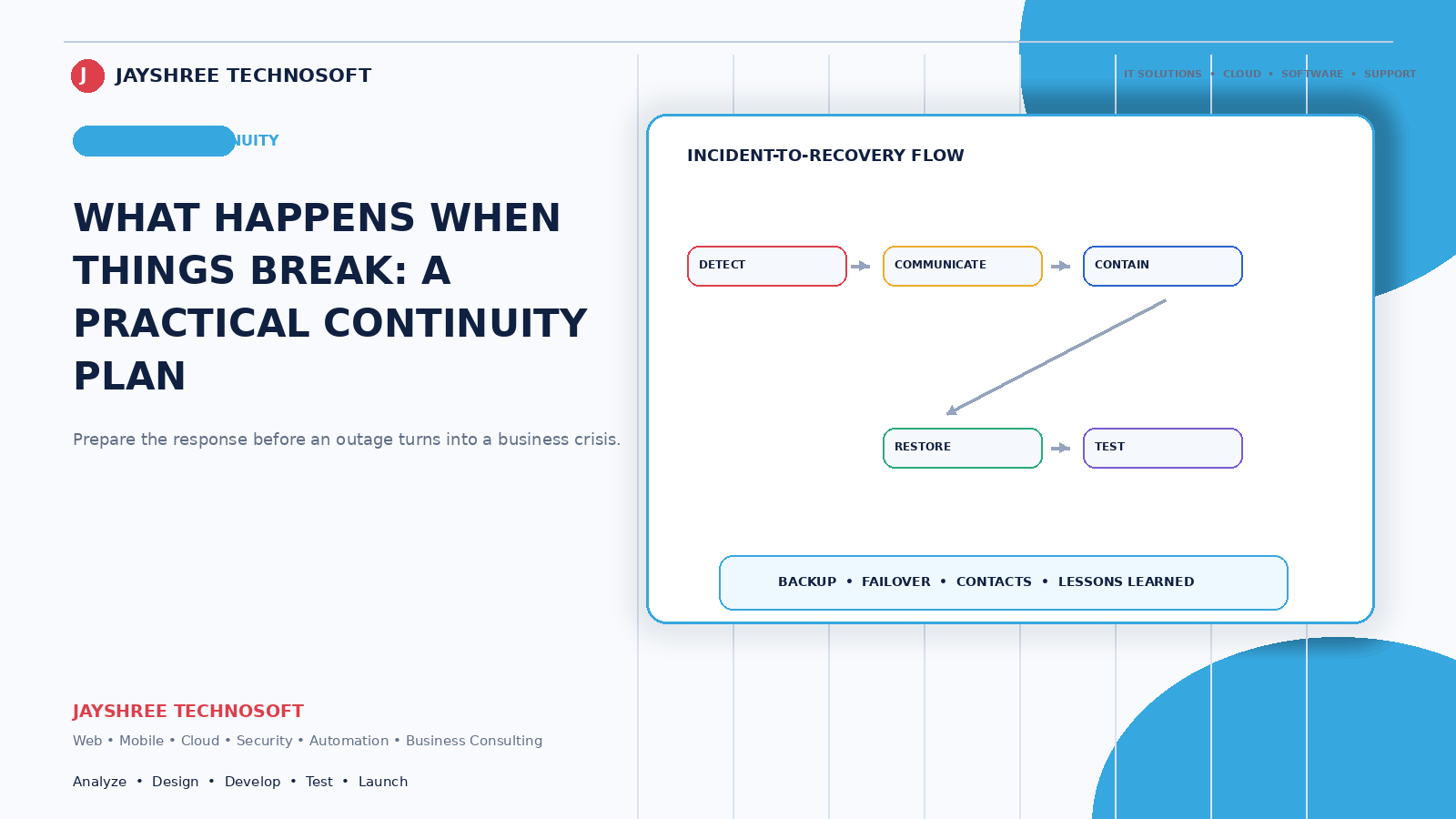
Establish what's actually affected. One machine, one system, or everything.
Switch to the fallback — paper, phone, alternate connection — rather than waiting for a fix.
Tell customers before they discover it. A brief message saying you're aware and working on it prevents most frustration.
Don't act destructively. Particularly with suspected ransomware: don't pay, don't restore over the top of everything without understanding the cause, and don't delete evidence of what happened.
Call the right person, which is why the plan has names and numbers.
After: The Part Businesses Skip
Once things are running, spend thirty minutes on what happened. What failed, what the fallback missed, what took longer than it should have, and what to change.
Most businesses that experience an outage do nothing afterwards and experience the same one again. The thirty minutes is what converts a bad day into a system that's better than before.
The Realistic Minimum
You don't need a formal programme. You need: backups that are tested rather than assumed, one page written down covering the critical three and who to call, at least two people who can do each essential task, passwords somewhere shared and controlled, and a way to keep billing and communicating when systems are down.
That's an afternoon of work and a quarterly check. It's the difference between an incident costing hours and one costing weeks.
How We Help
Jayshree Technosoft LLP works with businesses on backup configuration and testing, resilient infrastructure, offline-capable systems, and recovery when something has already happened — including businesses whose original setup was done by someone no longer contactable.
The most common recommendation we make costs nothing: test your backup this week. It's either reassuring or it's the most urgent thing on your list, and most businesses don't know which.
Want to know how your business would actually cope? Get in touch — we'll start with the backup test and the one-page plan.
Recent Articles

Best CRM Software in Jaipur for Kirana Stores: How POS Billing CRM Simplifies Daily Operations

How DataBridgeCRM's Real Estate CRM Works, From First Enquiry to Closed Deal

How LawDesk & CADesk Work for Lawyers and Chartered Accountants
