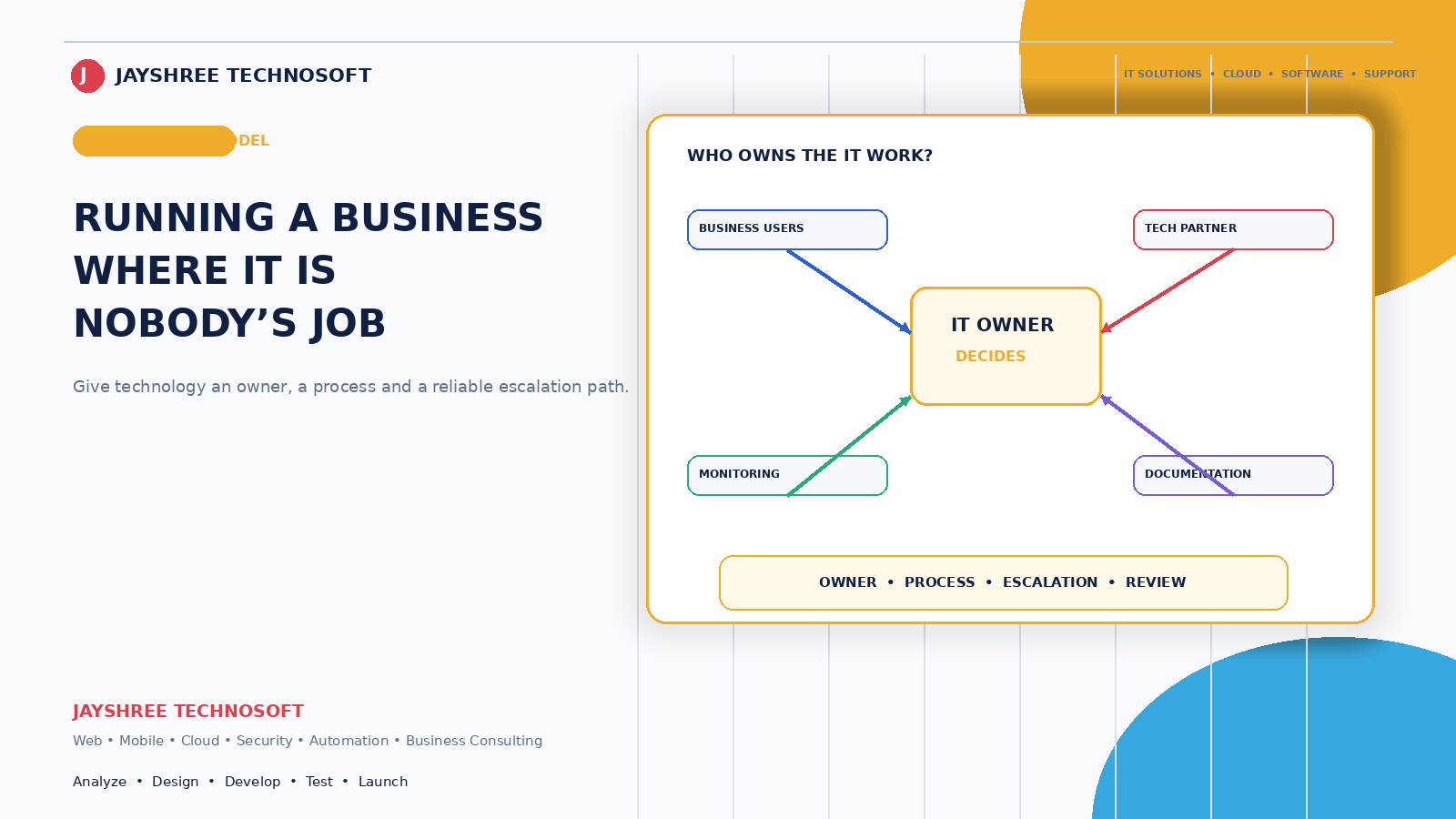
Most Indian small businesses have no IT person. What they have is whoever is best with computers — usually someone whose actual job is something else entirely, handling passwords, printer problems, and vendor calls alongside their real work.
That arrangement works until it doesn't, and the failures are predictable enough to prevent.
Jayshree Technosoft LLP works with businesses in exactly this position across Jaipur, Rajasthan, and India.
The Real Risk Isn't Technical
Businesses without IT staff imagine the danger is a technical failure they can't fix. In practice the damage comes from something simpler: nobody owns it.
Nobody knows what subscriptions are being paid for. Nobody checks whether backups are running. Nobody removes access when staff leave. Nobody notices the domain renewal notice going to a former employee's inbox.
None of these require technical skill to fix. They require someone whose responsibility it is.
The One-Page Document That Solves Most of It
Before any tools or vendors, write this down. It takes an afternoon and it's the highest-return IT work most small businesses can do:
Every system and subscription — what it does, who provides it, what it costs annually, and when it renews.
Every account and who holds credentials — domain, hosting, email, cloud storage, software, payment gateway, social media.
Backup arrangement — what's backed up, where, how often, and how to restore it.
Who to call for each system when something breaks.
Keep it somewhere accessible to more than one person. The value appears on the day the person who set everything up is unavailable — which is exactly when nobody can find any of this.
The Four Checks That Prevent Most Disasters
None of these require technical knowledge, and all four are regularly skipped.
1. Is your domain registered in your business's name, with renewal notices going to an email you control? Expired domains are among the most avoidable business disasters, and they almost always happen because the notice went to a former employee or a developer. Check today.
2. Can someone restore a file from backup right now, while you watch? Almost every business believes it has backups. Considerably fewer have working ones. This test takes an hour and produces either reassurance or an urgent priority.
3. Does anyone who has left still have access to anything? Email, systems, shared accounts, WhatsApp groups. This is the most common real security failure in small businesses, and it's entirely a process problem.
4. Is two-factor authentication on your important accounts? Email, hosting, domain, payment gateway, and banking. Twenty minutes to enable, and it prevents the most common account compromises.
Reduce What You Have to Manage
The simplest way to manage IT without IT staff is to have less of it to manage.
Choose cloud over local wherever sensible. No server to maintain, no updates to apply, no hardware to replace. Failures become the provider's problem rather than yours.
Prefer fewer, connected systems over many disconnected ones. Five subscriptions with manual data movement between them requires more management than one connected platform — and the manual movement is itself a hidden cost. This is a genuine argument for consolidated systems like DataBridgeCRM for businesses without technical staff: one system to learn, one vendor to call, one place data lives.
Choose managed services over self-managed. Managed hosting costs more monthly and removes the need for someone to apply security updates. For a business without IT staff, that trade is almost always correct.
Cancel what nobody uses. The audit above usually finds something.
Who Should Own It Internally
Someone has to, and it doesn't need to be technical.
What the role actually requires: keeping the document above current, checking the four items quarterly, being the point of contact for vendors, and knowing who to escalate to. That's an administrative responsibility, not an engineering one.
What it should not be: an informal expectation on whoever is good with computers, alongside their real job, with no authority and no time allocated. That arrangement produces neither good IT nor a happy employee.
Name the person, allocate an hour a month, and give them authority to spend on small things without approval. That alone changes outcomes.
When to Bring in Outside Help
Ongoing support arrangement makes sense when you have systems that break, staff who need help, and no internal capability. Agree what's covered, response times, and cost before you need it — negotiating during an outage is expensive.
Project help for setting up new systems, migrations, or fixing something specific.
An annual review, which is genuinely worth it — someone independent looking at what you have, what it costs, what's at risk, and what could be simplified.
What to avoid: calling someone only in emergencies, with no relationship and no understanding of your setup. Emergency support from someone unfamiliar with your systems is slow and expensive.
The Quarterly Fifteen Minutes
Put this in a calendar and it prevents most of what businesses call us about urgently:
Check the four items above. Review subscriptions and cancel anything unused. Confirm the document is current. Note anything that has been irritating people, since small persistent problems usually have simple fixes nobody got around to.
An hour a year, and it's the difference between IT that quietly works and IT that produces occasional crises.
How We Work With Businesses Like This
Jayshree Technosoft LLP supports businesses without internal IT staff — the annual review, ongoing support arrangements, system setup, and the simplification work that reduces how much there is to manage in the first place.
Our starting point is usually the audit rather than a proposal. A meaningful share of these engagements produce three specific fixes and a shorter subscription list rather than a project — which is a cheaper outcome and the one that builds the relationship.
Running a business where IT is nobody's actual job? Get in touch — start with the four checks above, and call us for whatever they turn up.
Recent Articles

Best CRM Software in Jaipur for Kirana Stores: How POS Billing CRM Simplifies Daily Operations

How DataBridgeCRM's Real Estate CRM Works, From First Enquiry to Closed Deal

How LawDesk & CADesk Work for Lawyers and Chartered Accountants
