Most Indian businesses running unlicensed software aren't doing it deliberately. Someone installed something years ago, it worked, nobody asked, and it became part of how the business runs.
The risk sits quietly until it doesn't — and the consequences are usually financial rather than dramatic.
Jayshree Technosoft LLP works with businesses on exactly this, and this is a practical view rather than a lecture.
Why This Matters More Than It Used To
Three things changed.
Software companies got better at detecting it. Modern applications frequently check licence status online. Detection no longer requires anyone visiting your office.
Unlicensed software carries real security risk. Cracked versions come from somewhere, and that somewhere frequently adds something. A meaningful share of malware infections in small businesses arrive this way — and the business that saved on a licence pays considerably more on recovery.
Clients ask. Enterprise buyers, international clients, and government contracts increasingly require confirmation that you use licensed software. This has quietly become a commercial issue rather than only a legal one.
What Businesses Usually Have Wrong
Design and creative software. The most common category. Expensive, widely pirated, and heavily monitored by its publishers.
Operating systems. Machines running unactivated or improperly licensed versions, frequently from a computer shop that "handled it."
Office and productivity software. Often a single licence installed across many machines.
Development tools and databases. Free for individuals or small teams, licensed above certain thresholds that businesses cross without noticing.
Fonts. Genuinely overlooked. Commercial use of fonts requires appropriate licensing, and design work using improperly licensed fonts creates exposure for both you and your client.
Stock images. Images taken from search results and used on websites and marketing material. Rights holders actively pursue this, and demands arrive years later.
The Audit That Takes an Afternoon
You cannot fix what you haven't found.
Go machine by machine and list what's installed. For each item: what it is, whether you have a licence, how many people use it, and what it costs to license properly.
Two things reliably surface. Software nobody uses that you could simply remove — which reduces both cost and exposure. And software everybody depends on that nobody licensed.
Do the same for your website and marketing material: fonts, images, plugins, and themes.
The Cheaper Paths Businesses Miss
The assumption is that going legal means paying full price for everything. Frequently it doesn't.
Free and open-source alternatives are genuinely good for many business needs — office suites, design tools, development environments. For a business using a fraction of an expensive application's features, this is often the sensible answer rather than a compromise.
Subscription instead of purchase. Monthly licensing spreads cost and frequently works out cheaper than an outdated perpetual licence you'd need to replace anyway.
Right-sizing your editions. Businesses commonly pay for professional editions when standard ones cover their actual use — or would, if anyone had checked.
Licence only who needs it. Five people needing design software doesn't mean twenty licences.
Free tiers. Many tools are free below certain usage thresholds that small businesses never cross.
A proper audit frequently reveals that going fully legal costs less than expected, because half the software wasn't needed.
Fonts and Images, Specifically
These cause disproportionate trouble because they feel like small details.
Fonts: use fonts with clear licences for commercial use. Extensive free libraries exist with permissive terms, and for most business purposes they're entirely adequate. If you commission design work, confirm what fonts were used and under what licence — you inherit the exposure.
Images: never take images from search results. Free stock libraries offer images usable commercially without attribution, and paid stock is inexpensive relative to the cost of a rights claim. Keep a record of where each image came from — years later, that record is what resolves a query quickly.
This matters equally for marketing material, which is why we handle licensing properly in the design and campaign work done through Suriya Advertisement as well — an image used in an advertisement carries the same exposure as one on a website.
Keeping Track Afterwards
The audit is the easy part; not drifting back is the discipline.
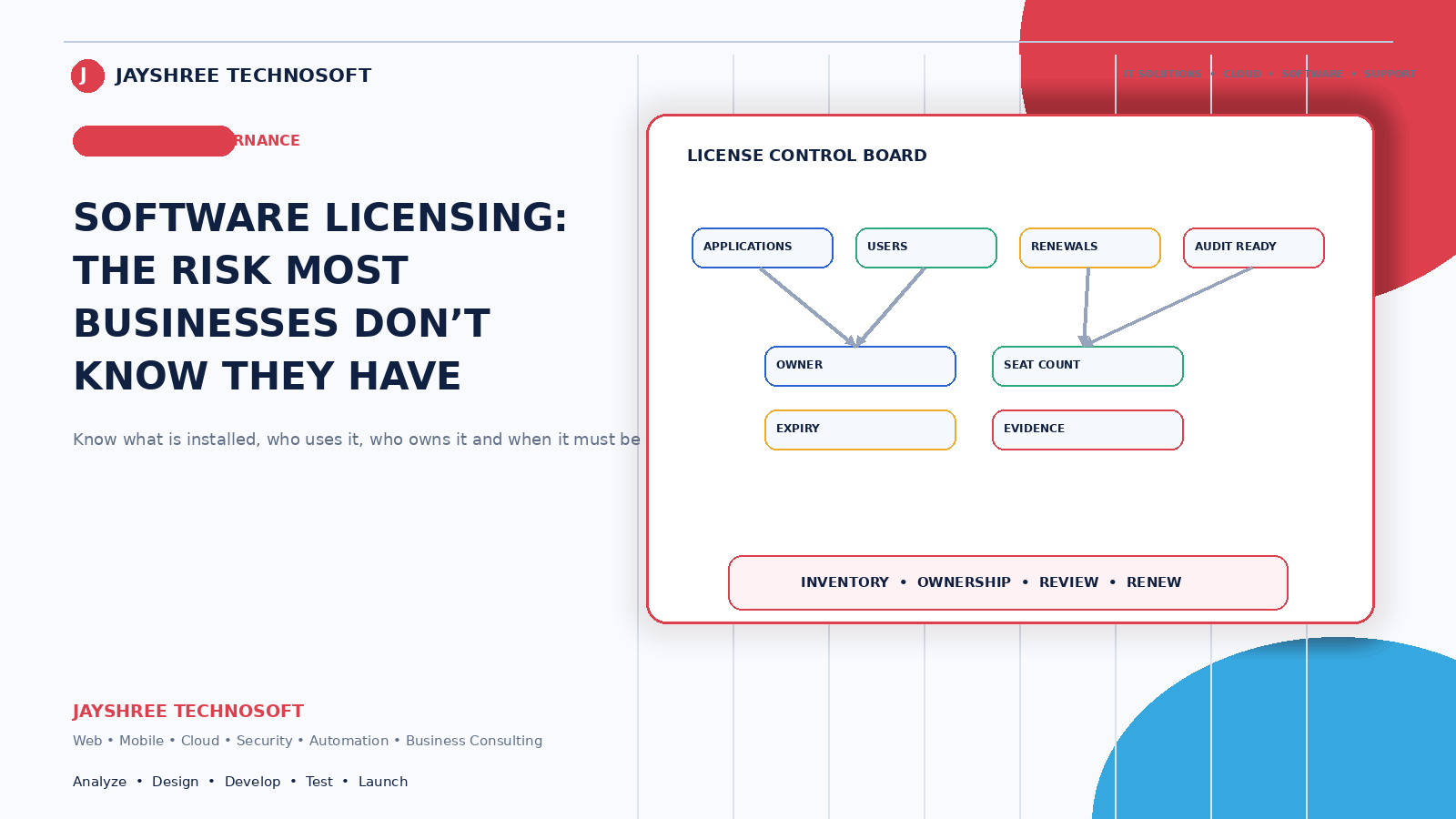
Keep a licence register. What you own, how many seats, renewal dates, and cost. One spreadsheet, reviewed annually.
Control who can install software. On business machines, installation should require someone with authority. Most unlicensed software arrives because a well-meaning employee installed something to solve a problem.
Include it in your joining and exit process. Software provisioned properly when someone joins, licences reclaimed when they leave.
Check renewals before they lapse. Expired licences are a common and entirely avoidable form of non-compliance.
What This Costs You to Ignore
Beyond the legal exposure, which is real: security incidents from compromised installers, incompatibility and instability from cracked versions, no vendor support when something breaks, contracts you can't bid for, and the awkward position of discovering exposure during a client's due diligence rather than on your own schedule.
The last one is the most common commercial consequence. A deal delayed while you sort out licensing is more expensive than the licences.
How We Approach It
Jayshree Technosoft LLP works with businesses across Jaipur, Rajasthan, and India on software audits and rationalisation — finding what's installed, identifying what's actually needed, recommending appropriate licensing or genuine alternatives, and setting up the tracking that prevents drift.
Our experience is that most businesses in this position end up spending less than they feared, because the audit removes software nobody was using and right-sizes what remains.
Unsure what your business is actually running? Get in touch — the audit is straightforward and the answer is better known on your terms than a client's.
Recent Articles

Best CRM Software in Jaipur for Kirana Stores: How POS Billing CRM Simplifies Daily Operations

How DataBridgeCRM's Real Estate CRM Works, From First Enquiry to Closed Deal

How LawDesk & CADesk Work for Lawyers and Chartered Accountants
