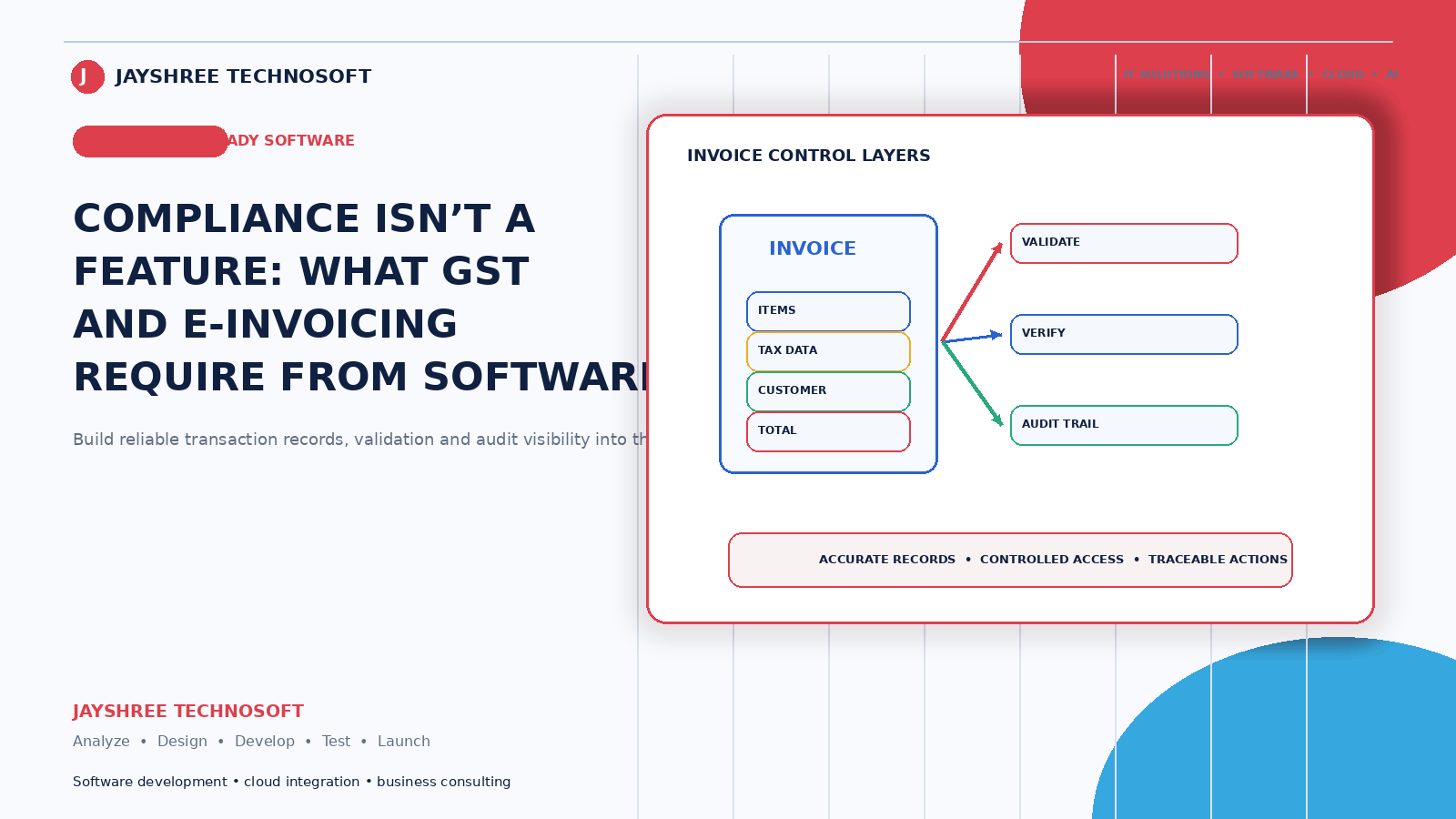
Compliance is not a feature you add to business software. It's a constraint the software has to be built around — and businesses discover this at the worst possible moment, usually when a return is being filed or an audit query arrives.
Jayshree Technosoft LLP has built billing and business systems for Indian companies since 2009. This is what compliance actually requires from your software, and what to check before you buy or build anything.
A note: GST rules and e-invoicing thresholds change periodically. Treat this as orientation and confirm current requirements with your CA — that's not a disclaimer, it's practical advice, because the details genuinely shift.
Why This Belongs in the Software Conversation
Businesses often treat compliance as their accountant's problem. The accountant then discovers that the billing software produces invoices missing required fields, records data in a format that can't be filed, or can't generate the reports needed for reconciliation.
At that point you have two bad options: manual rework every month, or replacing software you just paid for.
The compliance questions belong in the buying conversation, not after it.
What Your Billing Software Must Handle
Correct tax treatment per item. Different products and services attract different rates. A system where tax is set at the invoice level rather than per line item will produce wrong invoices the moment you sell mixed goods.
Proper invoice format with all required particulars — your details, the customer's, tax breakup, and the numbering that regulations require. Invoice numbering in particular must be sequential and consistent; systems that allow gaps or duplicates create problems that surface during scrutiny.
The distinction between intra-state and inter-state supply, which determines how tax is applied. This should be automatic based on the customer's location rather than something staff select manually — because staff will select wrongly during a busy hour.
Credit and debit notes linked to original invoices, for returns and corrections.
Reports your CA can use directly. This is the practical test. Ask your accountant what they need at filing time, then ask the vendor to produce exactly that in the demo.
E-Invoicing: Check Whether It Applies to You
E-invoicing requires invoices to be reported to a government portal, which returns a unique reference number before the invoice is valid. Applicability depends on turnover thresholds that have been progressively lowered over time — which means businesses that were exempt last year may not be this year.
Two practical points:
Check your current applicability with your CA rather than assuming. Thresholds change, and the consequence of missing the transition is invoices that aren't legally valid.
If you're near a threshold, buy software that supports e-invoicing even if you don't need it yet. Adding it later to a system that wasn't designed for it is considerably harder than having it available and unused.
Similarly, e-way bill generation matters if you move goods — and it should connect to your invoicing rather than being a separate portal exercise.
The Questions to Ask Any Vendor
Test these in the demo rather than accepting assurances:
Show me an invoice with three items at different tax rates.
Show me what happens when I bill a customer in another state.
Show me a credit note against an existing invoice.
Show me the reports my CA gets at filing time.
Does it support e-invoicing, and what happens if we cross the threshold?
How are invoice numbers handled — can gaps or duplicates occur?
When rules change, who updates the software and is that included?
That last question matters more than most. Compliance requirements change; software that isn't maintained becomes non-compliant quietly.
Record-Keeping Requirements
Beyond invoicing, businesses must retain records for prescribed periods. Practically, that means:
Your data must be exportable. If you leave a software provider, you need your historical records in usable form. Ask this before signing, not during a dispute.
Backups matter for compliance, not just disaster recovery. Losing three years of transaction data creates a problem beyond inconvenience.
Audit trails. Who created, modified, or cancelled an invoice, and when. Systems allowing silent edits to issued invoices create risk.
The Data Protection Layer
India's data protection framework applies to businesses handling personal information — which includes customer contact details, employee records, and anything similar.
Practically, for most small businesses: collect only what you need, control who can access it, keep it secure, and be able to say where it's stored. Software that gives every user access to everything is a liability as much as a convenience risk.
Sector-specific rules apply on top for payments, financial services, and healthcare — and those are stricter than the general framework.
Where Businesses Get Caught Out
Software that was compliant when bought. Rules changed, the vendor didn't update, and nobody noticed until filing.
Manual workarounds that break the trail. Invoices edited in Excel after generation, or numbers maintained separately. Whatever the reason, it creates gaps that are hard to explain later.
Multiple systems that disagree. Billing software and accounting software showing different figures, reconciled manually each month. Every reconciliation is an opportunity for a discrepancy nobody catches.
Assuming the accountant will handle it. Your CA files from what your systems produce. If the systems produce it wrongly, the filing inherits the problem.
The Practical Standard
Your billing and business software should produce compliant documents automatically, generate the reports your CA needs without manual assembly, maintain a clean audit trail, keep your data exportable, and be maintained as rules change.
That's a reasonable expectation, not a premium requirement — and software that doesn't meet it will cost you more in monthly rework than the difference in price.
How We Build It
Jayshree Technosoft LLP builds billing and business systems for companies across Jaipur, Rajasthan, and India with compliance treated as a design requirement rather than a module — correct tax handling per line item, proper invoice numbering and audit trails, reports built around what accountants actually need, and data you can export whenever you want.
We also work with businesses whose existing system produces compliance headaches every month, which is frequently a fixable problem rather than a replacement one.
Building or replacing a billing system, or dealing with monthly rework at filing time? Get in touch — and involve your CA in that conversation. The requirements are theirs; the software is ours.
Recent Articles

Best CRM Software in Jaipur for Kirana Stores: How POS Billing CRM Simplifies Daily Operations

How DataBridgeCRM's Real Estate CRM Works, From First Enquiry to Closed Deal

How LawDesk & CADesk Work for Lawyers and Chartered Accountants
