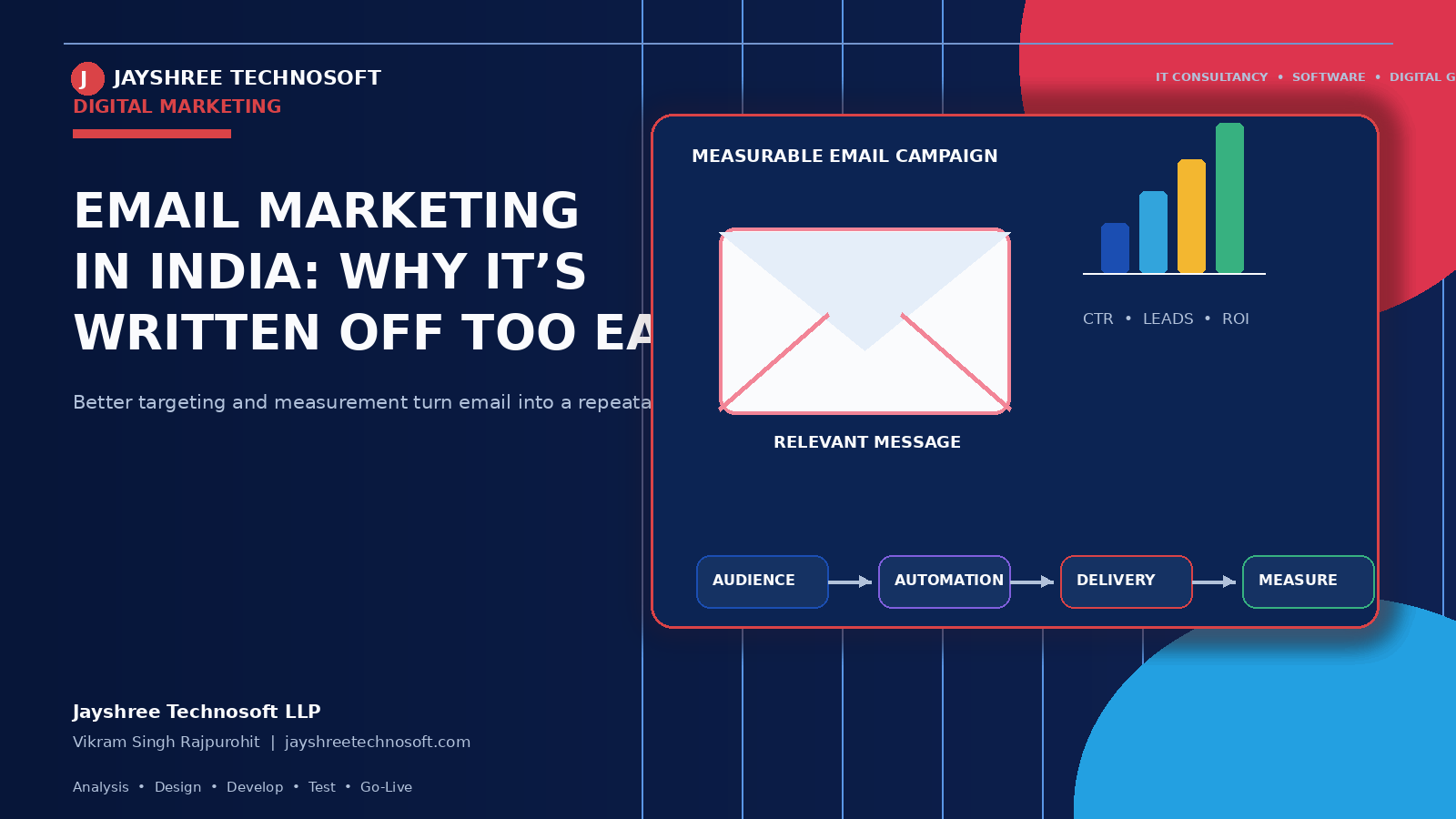
Email marketing is often dismissed after a few
disappointing campaigns.
The team sends a newsletter, receives limited responses,
and decides that customers do not read emails. Another business sends the same
message to every contact, sees unsubscribes, and concludes that email is
outdated. A third company has a large database but no reliable way to know
whether the list is current, segmented, or connected to the sales process.
These are not necessarily email problems. They are system
and strategy problems.
Effective email marketing services in
India should involve more than bulk sending. They should connect
audience understanding, content, timing, automation, consent, measurement, and
follow-up.
Why a basic broadcast approach underperforms
A single message to a mixed audience assumes that every
contact has the same need and is at the same stage. That is rarely true.
A new enquiry may need an introduction. An existing
customer may need onboarding or support. A returning buyer may respond to a
different offer. A business prospect may need a case study, product
explanation, or consultation invitation. Sending the same message to everyone
makes relevance difficult.
The second problem is weak measurement. Opens and clicks
can provide signals, but the business should also understand what happens after
engagement. Did the contact request information? Visit a service page? Start a
conversation? Complete a purchase? The value of email depends on the business
outcome it supports.
A stronger email marketing system has five parts
1. Clean audience structure
Start with the information the business already has.
Separate customers, leads, prospects, partners, inactive contacts, and internal
records. Add useful context such as industry, service interest, location,
purchase history, or enquiry stage where appropriate.
2. Relevant message design
Email should answer a customer question or help the
recipient take a useful next step. The content may be educational, promotional,
operational, or relationship-based, but it should have a clear purpose.
3. Automation and timing
Some messages are triggered by an event: a new enquiry, a
download, a demo request, a purchase, or an inactive period. Automation helps
the business respond consistently without requiring someone to remember every
follow-up.
4. Testing and measurement
Test the subject, message, call to action, audience, and
timing. Measure the action that matters to the business, not only the activity
inside the email platform.
5. Integration with sales and service
If a contact responds to an email but the sales team
cannot see the context, the opportunity is lost. A marketing system becomes
more useful when it connects with CRM records, enquiry handling, customer
communication, and reporting.
How Jayshree Technosoft fits the problem
The company’s Marketing Services page describes SEO,
social media marketing, mobile app marketing, analytics, Google Ads, Meta Ads,
brand awareness, customer loyalty, inbound traffic, customer insights, brand
authority, conversions, and marketing ROI.[3] The homepage also lists email
marketing, WhatsApp marketing, SMS marketing, social media tools, and
AI-powered marketing within its broader technology and business-solutions
positioning.[1]
This matters because email should not be treated as an
isolated channel. It should support a wider digital-growth system that includes
the website, search visibility, social presence, sales process, and customer
experience.
Common mistakes to avoid
Do not purchase or use a contact list without
understanding permission and relevance. Do not hide the purpose of a message.
Do not send every campaign from a personal inbox. Do not measure success only
by the number of emails sent. Do not automate a confusing process before
defining the customer journey.
A smaller, better-organised audience can be more useful
than a large database that nobody understands.
Start with one customer journey
Choose one practical journey: new enquiry follow-up,
service education, abandoned enquiry, customer onboarding, repeat purchase, or
event registration. Define the audience, the first message, the next action,
the time between messages, and the handoff to a person when needed.
Then connect the results to the business outcome. If the
goal is consultation enquiries, measure qualified conversations. If the goal is
customer retention, measure repeat activity or support resolution. If the goal
is education, measure the actions that show improved understanding.
Email marketing is not too old for modern business. Poorly
designed email systems are simply too disconnected from the customer and the
business process.
If your campaigns are being written off after a few sends,
review the audience, message, automation, and measurement before abandoning the
channel. The goal is not to send more email. The goal is
to create more relevant customer conversations.
CTA: Ask Jayshree Technosoft
to review your email, CRM, website, and digital-marketing workflow and design a
measurable next step.
Recent Articles

Best CRM Software in Jaipur for Kirana Stores: How POS Billing CRM Simplifies Daily Operations

How DataBridgeCRM's Real Estate CRM Works, From First Enquiry to Closed Deal

How LawDesk & CADesk Work for Lawyers and Chartered Accountants
