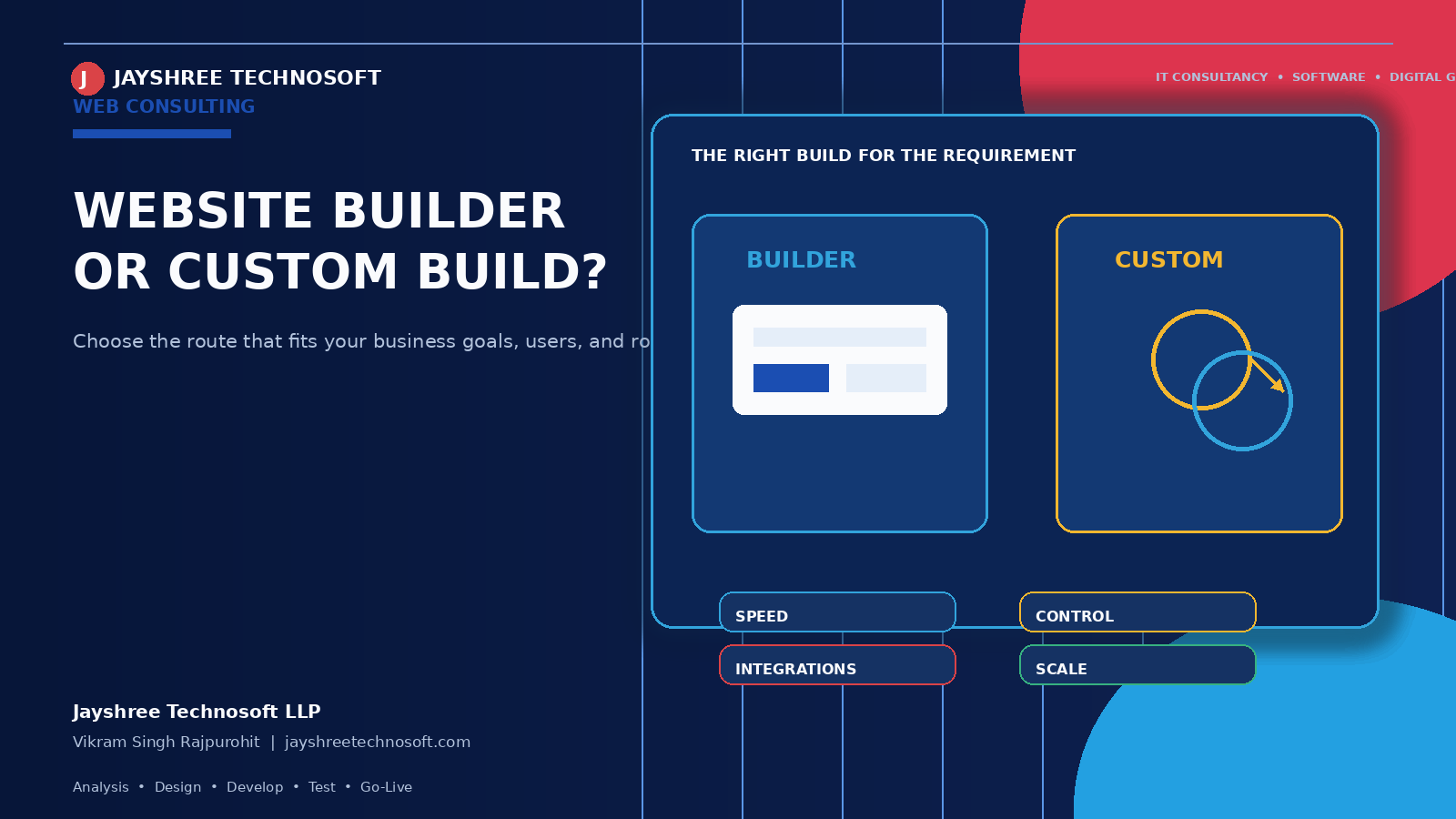
The question is often presented as a technology argument:
should a business use a website builder or hire a custom web development
company?
That framing is too narrow. The correct choice depends on
the role the website plays in the business.
A brochure site, a local service website, an ecommerce
store, a customer portal, and a workflow-heavy web application do not have the
same requirements. Choosing a platform before understanding the business can
create either unnecessary cost or long-term limitations.
When a website builder may be the right choice
A website builder can be practical when the primary goal
is to launch quickly, publish standard pages, manage content easily, and keep
the technical setup simple. Builders may be suitable for small business
websites, landing pages, early-stage validation, or teams that need to update
content without developer support.
The important questions are whether the templates support
the brand, whether the site can meet performance and SEO requirements, whether
the required integrations are available, and whether the platform’s pricing and
ownership terms make sense for the business.
A builder is not automatically a low-quality choice. A
well-planned website on a managed platform can be more useful than an expensive
custom build that nobody maintains.
When custom development becomes valuable
Custom development becomes more relevant when the website
must support distinctive workflows, complex integrations, user accounts,
marketplaces, dashboards, advanced permissions, or an experience that standard
templates cannot provide.
A custom build may also be appropriate when the website is
part of the core operating system of the business. For example, a booking
platform, a healthcare portal, a property marketplace, a logistics dashboard,
or an ecommerce application may need custom rules that sit beyond ordinary page
management.
Jayshree Technosoft’s Web Development page describes
high-performance, secure, scalable web solutions, custom web applications,
responsive and search-engine-friendly websites, and experience with PHP,
Python, Laravel, Node.js, Angular, WordPress, Shopify, and Wix.[1] This range
reflects an important consulting principle: the technology should follow the
requirement.
Compare the decision across six dimensions
Speed to launch
A builder usually offers a faster starting point. Custom
development generally requires more discovery and planning, especially when
integrations and business rules are involved.
Control over the experience
A builder provides speed through predefined components.
Custom development provides more control over the user journey, data flow, and
functionality.
Integrations
Check whether the platform supports the tools the business
already uses: payment providers, CRM, ERP, analytics, marketing, inventory,
shipping, or internal systems.
SEO and performance
The platform should support clean structure, page speed,
mobile usability, metadata, redirects, content management, and measurement. SEO
is not guaranteed by choosing either route.
Maintenance and ownership
Understand who can access the website, who owns the
content and code, how backups are handled, and how changes will be made after
launch.
Future scale
A platform that is suitable today may become restrictive
if the business expects new locations, products, customer accounts,
integrations, or transaction volume. The decision should include the next stage
of the roadmap without overbuilding for an imaginary future.
The best answer may be hybrid
A business does not always need to choose one route for
everything. It may launch the marketing website on a builder while developing a
custom customer portal. It may use Shopify for ecommerce and build a separate
internal application for operations. It may start with WordPress and introduce
custom integrations as the business learns what customers actually need.
The right architecture separates what must be flexible
from what can remain standard.
A practical consultation process
Begin by defining the business goal, audiences, workflows,
content responsibilities, integrations, security needs, and success measures.
Review examples of the current process rather than discussing only design
preferences. Then compare the total cost of ownership, including build,
hosting, maintenance, support, content, analytics, and future changes.
Jayshree Technosoft describes its delivery process as
analysis, design, development, testing, and go-live, with ongoing support after
launch.[2] This helps turn a website decision into a structured project rather
than a platform debate.
If you are unsure whether your business needs a builder, a
custom website, or a combination of both, do not begin with a theme or
technology stack. Begin with the customer journey and the
business process the website must support.
CTA: Share your website requirements with Jayshree Technosoft and get a practical recommendation based on speed, control, integrations, and future scale.
Recent Articles

Best CRM Software in Jaipur for Kirana Stores: How POS Billing CRM Simplifies Daily Operations

How DataBridgeCRM's Real Estate CRM Works, From First Enquiry to Closed Deal

How LawDesk & CADesk Work for Lawyers and Chartered Accountants
