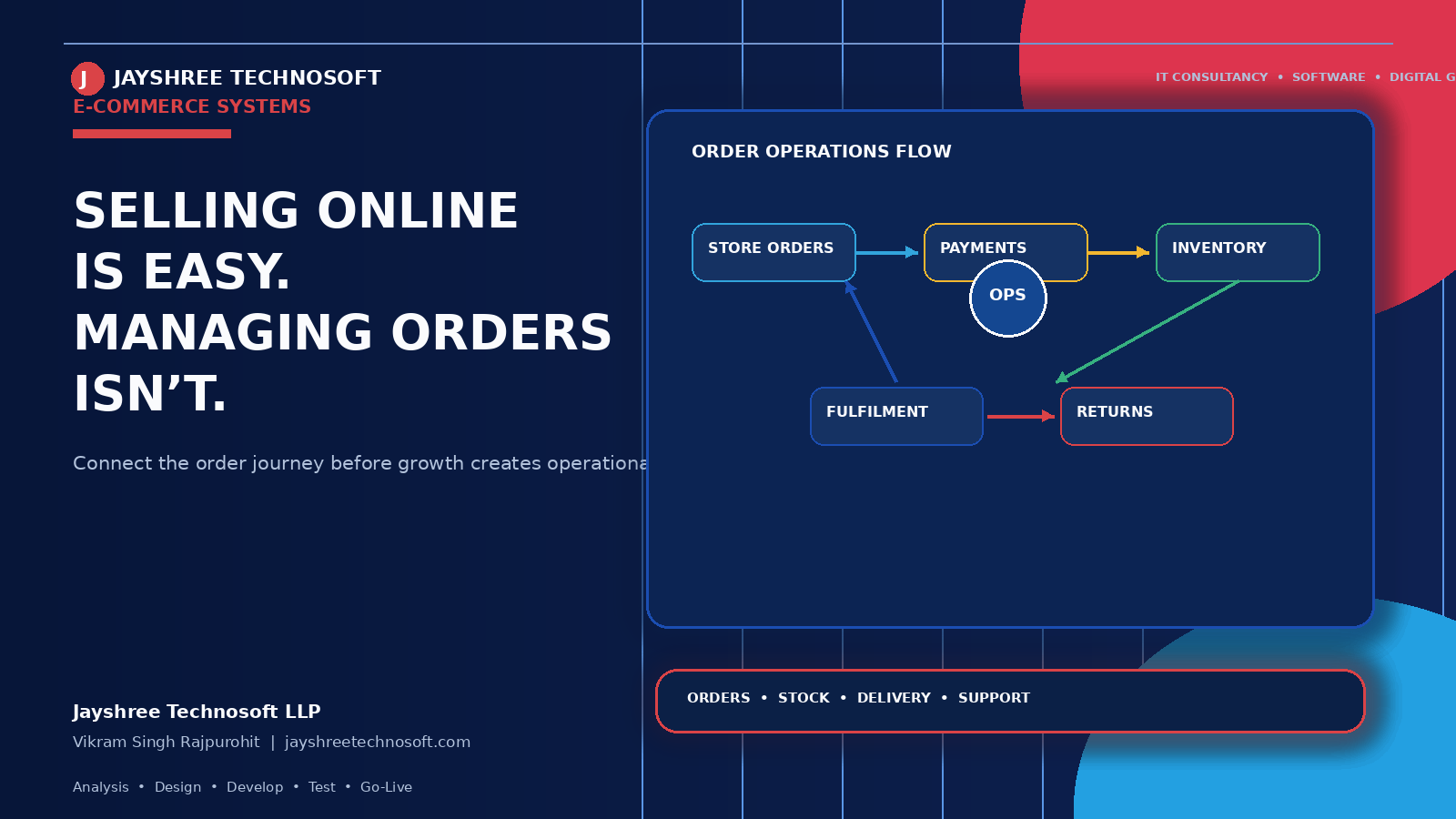
Launching an online store is easier than it used to be. A
business can publish products, connect a payment gateway, run campaigns, and
begin receiving orders without building a large technology team.
The difficult part begins when orders stop arriving in a
neat line.
Customers change addresses. Inventory is updated in more
than one place. A payment succeeds but the order is not marked correctly. A
product appears available even though another channel has already sold it. The
warehouse needs information that is sitting inside an email. Customer support
is answering “Where is my order?” without a reliable view of the delivery
status.
This is the point at which an ecommerce
order management system becomes a business decision rather than a
software upgrade.
The hidden cost of disconnected order processing
Many growing businesses use a combination of storefront
software, spreadsheets, messaging apps, payment dashboards, courier panels, and
accounting tools. Each system may work reasonably well on its own. The problem
is the handoff between them.
When a new order has to be copied manually into another
system, every additional order increases operational pressure. A team member
may enter the wrong quantity, miss a cancellation, or forget to update stock
after a return. These errors are not only technical issues. They create
refunds, delayed shipments, support requests, and a poor customer experience.
An IT consultancy should begin by mapping the process, not
by recommending a product name. The important questions are: Where does an
order begin? Which events change its status? Who owns each decision? Which
system is the source of truth? What should happen when a payment, stock count,
or delivery update does not match?
What an order management system should connect
A practical order-processing setup should provide a clear
flow from sale to fulfilment. Depending on the business, that flow may connect:
•
Storefront orders from a website or marketplace.
•
Payment confirmation and failed-payment handling.
•
Inventory availability across locations or sales
channels.
•
Packing, shipping, courier, and delivery status.
•
Cancellations, returns, exchanges, and refunds.
•
Customer notifications and support history.
•
Sales reporting and operational dashboards.
The goal is not to make every screen look complicated. The
goal is to reduce the number of times people re-enter the same information.
Jayshree Technosoft’s published web-development
positioning includes custom web applications, ecommerce platforms, payment
checkout funnels, process automation, customer-experience improvement, and
scalable support.[1] That combination is important because ecommerce operations
rarely fit perfectly into a generic workflow once a company has multiple
products, locations, sales channels, or fulfilment rules.
Signs that your current setup is under pressure
You may need a review of your order systems if your team
frequently checks several dashboards to answer one customer question. Other
warning signs include stock being corrected manually, orders being copied into
spreadsheets, sales and fulfilment teams working from different numbers,
recurring refund errors, or no clear owner for integrations.
Another sign is that the business cannot explain its order
status in a consistent way. If “processing,” “packed,” “shipped,” and
“delivered” mean something different to different teams, automation will only
make the confusion faster.
A sensible technology-consulting approach
Start with a process map. Document the customer journey,
internal handoffs, exceptions, and reports required by management. Then
separate essential requirements from desirable features. Decide what can be
handled by configuration and what requires custom development or integration.
After that, test one representative workflow: a successful
order, a failed payment, a partial fulfilment, and a return. A working
prototype or controlled pilot is more useful than a long feature list because
it reveals the real data and process problems early.
Jayshree Technosoft describes its delivery methodology as
analysis, design, development, testing, and go-live, followed by ongoing
support and performance optimisation.[2] That sequence is well suited to
ecommerce consulting because it keeps the focus on business operations rather
than software alone.
The objective is reliable fulfilment, not more dashboards
The right order management solution should help the
business fulfil accurately, respond faster, and understand what is happening
without chasing information across disconnected tools. Sometimes the answer is
better configuration. Sometimes it is an integration project. Sometimes the
business needs a custom application connected to its existing systems.
The correct choice depends on order volume, product
complexity, inventory structure, payment flow, fulfilment model, and growth
plans.
If your online sales are growing but the back office is
still operating through manual updates, a technology consultation can help you
identify the smallest system change that removes the largest source of
friction. Start with the process, then choose the
technology.
CTA: Tell Jayshree Technosoft how your orders move today, and request a practical review of your ecommerce workflow.
Recent Articles

Best CRM Software in Jaipur for Kirana Stores: How POS Billing CRM Simplifies Daily Operations

How DataBridgeCRM's Real Estate CRM Works, From First Enquiry to Closed Deal

How LawDesk & CADesk Work for Lawyers and Chartered Accountants
