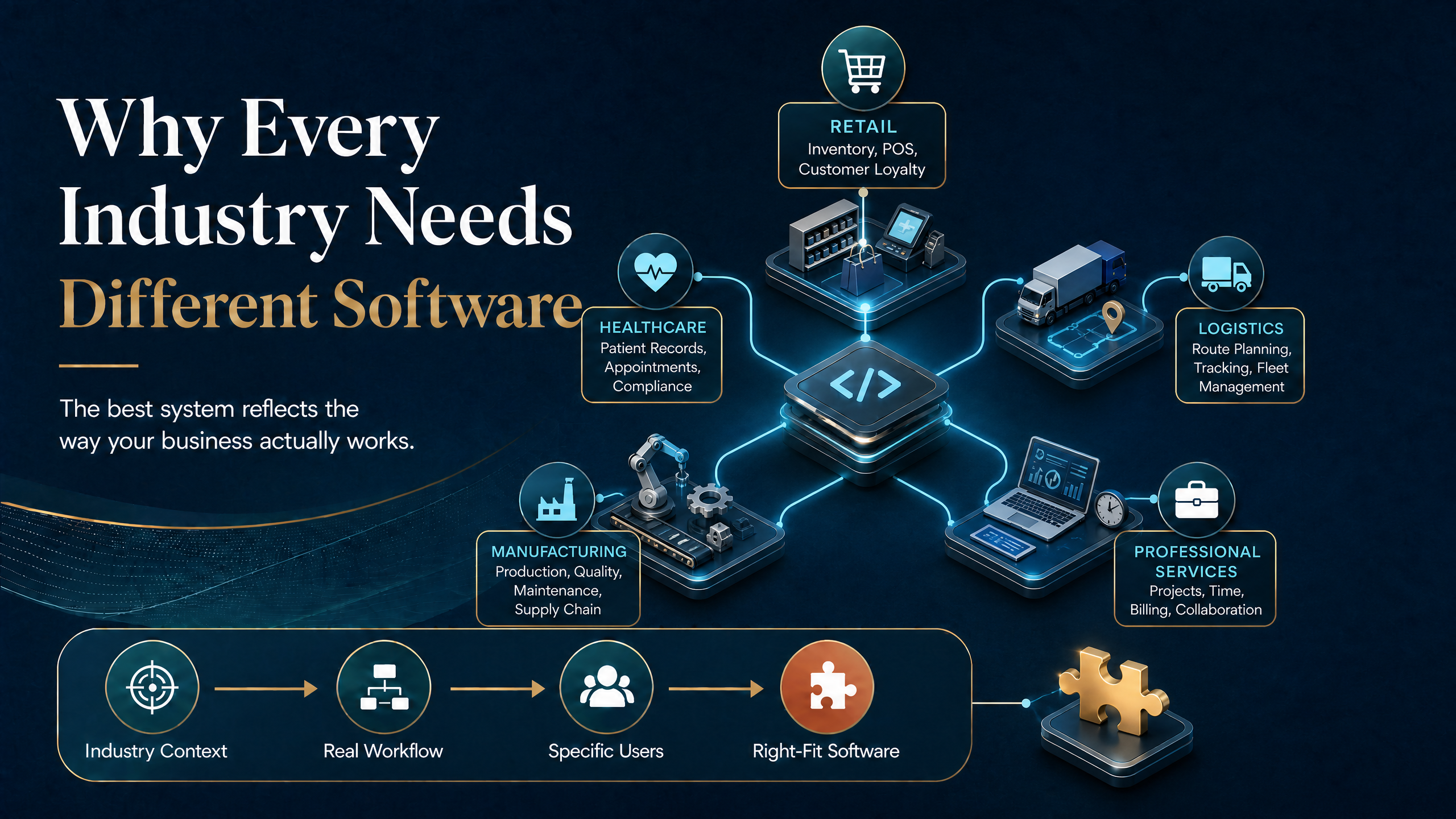
Generic software fits nobody perfectly. A hotel and a hospital both manage bookings, staff, and payments — and almost nothing about how they do it is the same.
Jayshree Technosoft LLP builds software across industries, and this article explains what actually changes from one sector to another, and why that determines whether a system gets used or abandoned.
Why Industry Fit Decides Adoption
Businesses usually evaluate software on features. In practice, adoption depends on whether the software matches how work actually happens.
When it doesn't, staff invent workarounds — a parallel register because the system can't handle a common situation, or fake data entered to get past a required field. Those workarounds are permanent hidden costs, and enough of them turn cheap software into expensive software.
Industry-specific design isn't about having more features. It's about the system assuming the right things by default.
Hospitality and Tourism
What's different: demand is seasonal and unpredictable. Bookings arrive through multiple channels including aggregators that charge commission. Guests expect communication before arrival and after departure. Rates change by date, occupancy, and season.
What software must handle: preventing double-bookings across channels, rate rules that vary by date, partial payments and advances, and automated guest communication.
What we see businesses actually want: reducing dependence on commission-heavy platforms by taking more direct bookings — which means the booking experience on their own website has to be genuinely good, not an afterthought.
Education
What's different: the cycle is seasonal around admissions. The person paying (parent) is different from the user (student). Fee structures are complex — term-wise, transport, sibling discounts, late fees, partial payments.
What software must handle: admission enquiry follow-up (where most revenue is actually won or lost), fee collection with automated reminders, attendance, and parent communication.
The India-specific requirement: reminders and notices on WhatsApp. Parents read WhatsApp; school emails largely go unread. Any system treating email as the primary channel was built for a different market.
Healthcare and Clinics
What's different: appointment scheduling with variable consultation lengths, patient records that must be accurate and confidential, follow-up visits, and prescriptions.
What software must handle: queue and appointment management, patient history accessible quickly during a consultation, billing that handles both cash and insurance-linked cases, and automated appointment reminders — which measurably reduce no-shows.
The sensitivity: patient data carries confidentiality obligations. Access control, audit trails, and careful handling matter more here than in most sectors.
Retail and Distribution
What's different: billing speed matters enormously — every extra second at the counter builds a queue. Stock accuracy is the difference between selling what you have and disappointing customers. GST compliance is constant.
What software must handle: fast barcode-driven billing, stock that updates on every sale, GST-compliant invoicing with correct rates per item, and customer history that survives staff changes.
The requirement people forget to ask about: billing that continues working when the internet drops. Power cuts and connectivity gaps are Indian retail reality, and a system that stops during one stops being trusted.
Manufacturing
What's different: raw materials become finished goods through defined stages. Purchase planning depends on production schedules. Costing needs to reflect materials, labour, and overhead.
What software must handle: bill of materials, production tracking through stages, purchase planning tied to demand, and job costing that reflects reality rather than estimates.
The practical constraint: shop-floor users often aren't comfortable with computers, and the environment isn't office-like. Interfaces need to be simple, tolerant of interruptions, and usable on whatever device is actually available.
Professional Services and Consultancies
What's different: the product is people's time. Projects run over weeks or months with milestones. Billing may be hourly, fixed, or retainer-based.
What software must handle: project and task tracking, time recording, milestone billing, and visibility of who is working on what — plus, critically, a clear view of the sales pipeline, because revenue depends on continuous business development.
What's Common Across All of Them
Despite the differences, some requirements are universal in Indian business software, and vendors who miss them build systems that get abandoned:
It works on a phone. Staff use phones more than computers in most Indian businesses.
WhatsApp is the communication channel. For customers, parents, patients, and suppliers alike.
UPI is the payment expectation. Any billing or collection system without it prominently placed creates friction.
GST compliance is built in, not an add-on module.
It tolerates connectivity gaps where the work happens away from reliable internet.
Your least technical employee can use it. This determines adoption more than any feature.
Off-the-Shelf or Built for You?
Our honest default: buy the ready-made product if one fits. Someone has already solved standard problems and spread the cost across thousands of customers.
Custom development earns its case when adoption would require significant workarounds, when your process genuinely differs from standard industry practice in ways that matter commercially, or when you're paying for several disconnected tools and still doing manual work between them.
A middle path we implement often: standard products for commodity functions, custom software only for the operational core that's genuinely yours, connected so data flows automatically.
How We Approach an Industry We're New To
We watch how the work actually happens before writing specifications. Descriptions in meetings and reality on the counter are consistently different, and specifications written from observation produce software people use.
Working in one of these sectors and unsure what your business actually needs? Get in touch — or see our industry experience. We'll tell you honestly if an existing product would serve you better.
Recent Articles

Best CRM Software in Jaipur for Kirana Stores: How POS Billing CRM Simplifies Daily Operations

How DataBridgeCRM's Real Estate CRM Works, From First Enquiry to Closed Deal

How LawDesk & CADesk Work for Lawyers and Chartered Accountants
