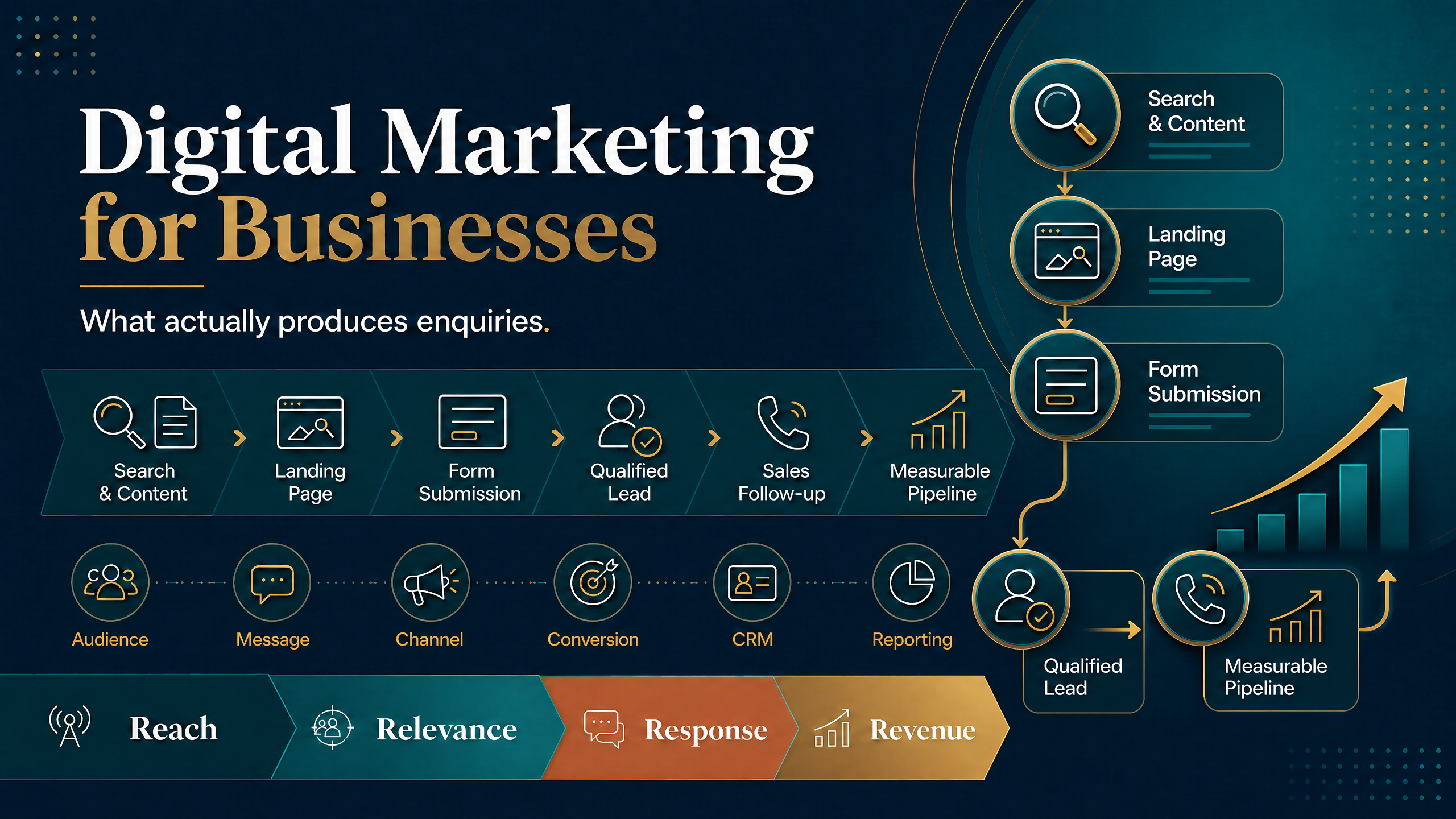
Digital marketing is the service most businesses buy without any way to judge whether it's working. Reports arrive full of impressions and reach, invoices get paid, and nobody can say whether it produced a single customer.
Jayshree Technosoft LLP provides digital marketing alongside development, and this article explains what actually works for Indian businesses — and how to tell whether what you're buying is real.
Start With the Only Question That Matters
How many enquiries did this produce, and what did each one cost?
Everything else — impressions, reach, followers, page views — is context at best and distraction at worst. If a marketing report doesn't answer that question, it's measuring activity rather than results.
This one shift changes what you buy. It's also why we insist on tracking being set up before any campaign begins, not after — because without it, nobody can tell you whether your money worked.
The Channels, and What Each Is Actually For
Search visibility (SEO)
What it is: appearing when someone searches for what you offer.
Why it matters most: the person searching already wants what you sell. This is the highest-intent traffic available, which is why it converts better than anything else.
The honest part: it takes months, not weeks. Anyone promising rankings in thirty days is either using tactics that cause penalties or describing keywords nobody searches for. Real SEO work is technical fixes, genuinely useful content, and earned links — and it compounds slowly.
Google Business Profile and local search
Frequently the highest return for local businesses, and it's free. When someone searches for a service near them, the map results appear above everything else. A properly maintained profile with photos, accurate details, and customer reviews often produces more enquiries than paid advertising.
Many Jaipur businesses either haven't claimed theirs or set it up once and abandoned it. If you do only one thing from this article, do this.
Paid advertising
What it's for: immediate visibility while slower channels build.
Where it's wasted: broad targeting, sending clicks to a homepage instead of a relevant page, and no tracking of what happened after the click. Most poorly performing ad accounts we review have the same problems — not bad ads, but no measurement.
Paid works when you know what a customer is worth to you. Without that number, you can't tell whether you're buying profitably.
Social media
Realistic expectation: useful for credibility, brand familiarity, and staying visible to people who already know you. Less effective as a direct enquiry source for most B2B and service businesses.
Businesses often over-invest here because activity is visible and measurable-looking, while under-investing in search where the buyers actually are.
The channel Indian businesses under-use commercially. Your customers read WhatsApp; they largely don't read marketing emails. Order updates, appointment reminders, and genuinely useful offers reach people here.
The rule that keeps it working: message only people who opted in, and send something worth reading. Purchased lists and daily promotions get your number blocked, and recovering a banned business number is painful.
What We See Wasting Money
Marketing before the website works. Driving traffic to a slow site that's hard to use on a phone is paying to lose people. Fix the destination first — it's cheaper and it improves every channel at once.
Vanity metrics in reports. Impressions and reach only go up. A number that can't go down can't tell you when something is wrong.
Guaranteed ranking promises. Nobody controls Google's results. Guarantees mean either meaningless keywords or risky tactics.
Everything at once. Small budgets spread across five channels produce nothing anywhere. Two channels done properly beat five done thinly.
No tracking. The most common and most expensive gap. If you can't trace an enquiry back to where it came from, every decision after that is guesswork.
Why We Do This Alongside Development
There's a practical reason these belong together, and it's not cross-selling.
Search visibility is largely determined during development — clean URLs, page speed on mobile data, proper titles and descriptions, structured data, and a site architecture search engines can read. Retrofitting these into a finished website costs considerably more than building them in.
Equally, marketing tells you what your website is failing at. Traffic that arrives and leaves immediately is a website problem, not a marketing one — and a team that does both notices, rather than blaming each other.
What to Ask Any Marketing Agency
Four questions that separate substance from activity:
What will you measure, and how will we know it worked? The answer should mention enquiries or sales, not reach.
How will we track where enquiries come from? If there's no answer, no results can be verified.
What would you fix on our website before spending on ads? A good answer here shows they're thinking about outcomes rather than billing.
What's realistic in three months versus twelve? Honest agencies distinguish between the two. Others promise both immediately.
A Sensible Starting Order
For most Jaipur and Rajasthan businesses, the sequence that works: fix the website's speed and mobile experience, set up tracking so you can measure anything, claim and properly maintain your Google Business Profile, then build search visibility for the terms your buyers actually use — adding paid advertising once you know what an enquiry is worth to you.
Unglamorous, and considerably more effective than starting with a social media calendar.
Want an honest assessment of what your business should do first? Get in touch — including if the answer is that your website needs fixing before any marketing spend makes sense.
Recent Articles

Best CRM Software in Jaipur for Kirana Stores: How POS Billing CRM Simplifies Daily Operations

How DataBridgeCRM's Real Estate CRM Works, From First Enquiry to Closed Deal

How LawDesk & CADesk Work for Lawyers and Chartered Accountants
