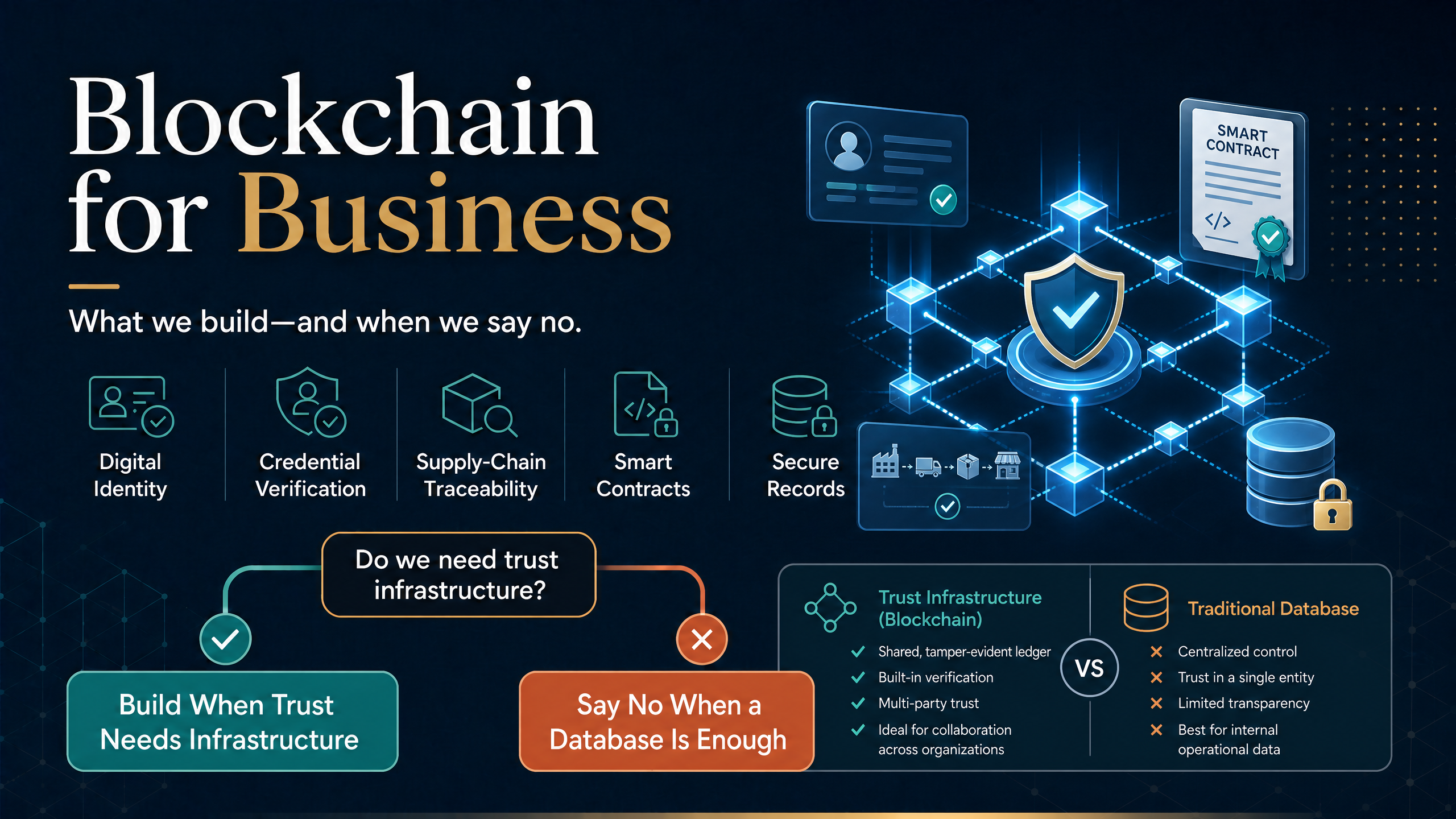
Blockchain is sold harder than it's explained. Businesses get pitched "decentralised solutions" without anyone stating plainly what they'd be buying, what it costs, or whether they need it at all.
Jayshree Technosoft LLP has worked in blockchain since 2015, before most Indian businesses had encountered the word. Our founder has delivered blockchain seminars at institutions including IIT Mumbai and the State Bank of India. This is the plain version of what we build and, more importantly, when we advise against it.
What Blockchain Actually Does
Strip away the vocabulary and it's a shared record that no single party can quietly alter.
Normally, records live in one company's database. Everyone else has to trust that company. A blockchain distributes the record so all parties can verify it independently, and changes are visible rather than silent.
That's the whole idea. Everything else is application.
The Test We Apply Before Any Project
Blockchain makes sense when three things are true together:
Multiple parties need to share the same data. Those parties don't fully trust each other or a single central authority. And a tamper-proof record has genuine value.
Miss any one of these, and a normal database will be faster, cheaper, and far easier to change. A substantial part of our consulting work is telling businesses exactly this — and it has earned us more long-term clients than any pitch, because a partner who says no once is believed when they say yes.
What We Build
Verification and certification systems. Tamper-proof records for certificates, documents, and credentials — where anyone can verify authenticity in seconds rather than waiting weeks for an issuing office to respond. In a market where document fraud is a persistent problem, this is the most deployable application available, and it requires no cryptocurrency.
Smart contracts. Agreements that execute automatically when conditions are met — milestone payments releasing on delivery confirmation, revenue splitting between parties by fixed rules, escrow without an escrow agent.
Supply chain tracking. Recording custody transfers as goods move between parties who don't share systems, with each participant able to verify the history.
Decentralised applications. Software where records live on a blockchain rather than one company's server — appropriate when the shared-trust condition genuinely applies.
Digital asset and token systems. For loyalty programmes, asset representation, and regulated digital-asset platforms, built with compliance flexibility given how the Indian regulatory picture continues to evolve.
Where It Genuinely Fits in Indian Business
The applications we see actually working share a pattern — boring, valuable problems rather than exciting ones:
Education and skilling. Degree and certificate verification, where employers currently wait weeks and fake credentials thrive in the gaps.
Multi-party trade and logistics. Where several independent businesses need a shared version of what happened.
Financial settlement between parties. Where reconciliation currently consumes real staff time.
Provenance and authenticity. Relevant to sectors where genuine origin carries commercial value.
What It Costs — and the Three Things That Move the Number
Costs vary enormously with scope, so treat any fixed price offered before understanding your requirements with caution. Three factors dominate:
Security audits. Anything handling real value should be independently audited before deployment. This is a separate, non-trivial cost and it is not optional — blockchain code cannot simply be patched after deployment the way ordinary software can.
Upgrade design. The immutability that makes blockchain trustworthy also means a bug is permanent unless upgrade paths were designed in advance. That decision must be made before writing code, not after.
The non-blockchain part. Most projects need a normal application around the blockchain component — interfaces, admin tools, integration with your existing systems. The blockchain is often the smallest part of the build.
Questions Worth Asking Any Blockchain Partner
Including us:
What have you deployed that's live and handling real value? Who audits your contracts, and can I see a past audit report? How do you handle bugs and upgrades after deployment? Which blockchain would you recommend for my case, and why not the others?
And the one that reveals the most: would you tell me if a normal application would serve me better? A partner who never recommends against blockchain is selling, not consulting.
Where the Market Actually Is
The hype cycle has cooled, and that's healthy. What remains is real adoption in credential verification, supply-chain tracking, settlement systems, and regulated digital-asset platforms.
India's regulatory framework around digital assets continues to evolve, which is why we build compliance flexibility in from the start rather than assuming today's rules are permanent. For most business applications — particularly verification systems — no cryptocurrency is involved at all, which keeps them outside that complexity entirely.
How to Start
Not with a technology decision. With a problem: where does your business currently depend on trusting a party you can't verify, or spend real effort reconciling records between organisations?
If that problem exists, blockchain may fit. If it doesn't, we'll tell you so, and you'll have saved a significant amount of money.
Considering a blockchain project, or unsure whether you need one? Get in touch — the honest answer first, a proposal only if it genuinely fits.
Recent Articles

Best CRM Software in Jaipur for Kirana Stores: How POS Billing CRM Simplifies Daily Operations

How DataBridgeCRM's Real Estate CRM Works, From First Enquiry to Closed Deal

How LawDesk & CADesk Work for Lawyers and Chartered Accountants
