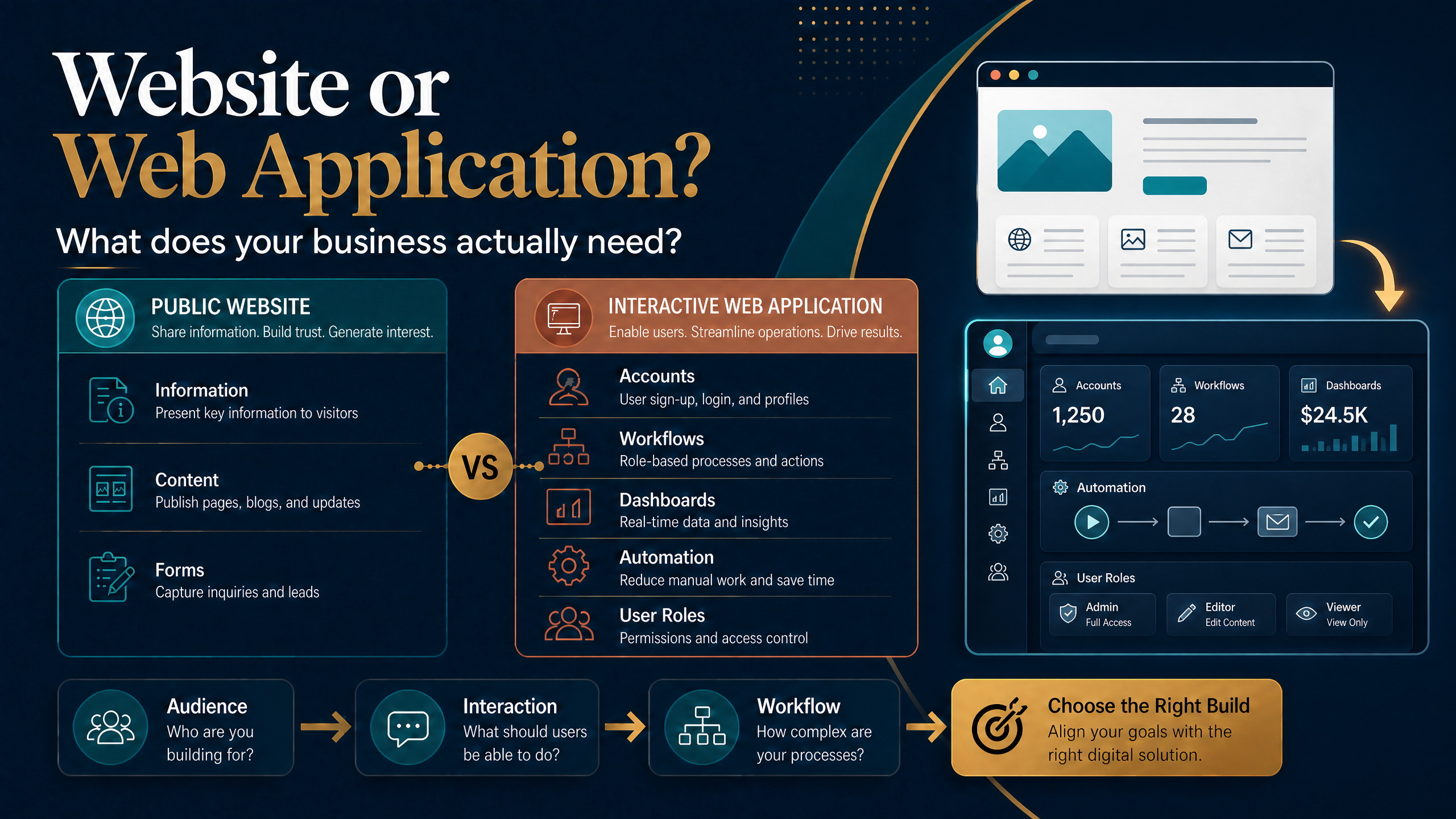
Most businesses know they need a website. Fewer realise that the thing actually holding them back is usually not a website at all — it's the absence of a system.
A website tells people about you. A web application does work for you. Jayshree Technosoft LLP builds both, and this article explains the difference and when a business needs the second one.
The Difference in One Line
A website presents information. Pages, services, contact details. Visitors read it.
A web application performs work. People log in, enter data, process something, and get an outcome. It has users, permissions, records, and logic.
The practical distinction: if it just needs to be read, it's a website. If people need to do something in it, it's an application — and it's priced and built accordingly, because it's software rather than pages.
What Businesses Actually Ask Us to Build
Over the years, the same needs recur:
Customer portals. Clients log in to see their orders, invoices, service history, or documents — instead of phoning your office to ask. Reduces support load and looks considerably more professional to business customers.
Booking and appointment systems. Customers book slots themselves, the system prevents double bookings, and reminders go out automatically. Used by clinics, service businesses, salons, and consultants.
Internal operations tools. The systems that replace the elaborate Excel file everyone depends on — job tracking, work allocation, approvals, field reporting.
Dashboards and reporting. Business owners who currently wait two days for numbers seeing them live instead.
Multi-user management systems. Where different people have different access — a manager sees everything, a salesperson sees their own customers, an accountant sees invoices.
Industry-specific systems. Software for how your business works, when no off-the-shelf product fits.
The Signals You Need an Application, Not Another Website
These come up in almost every conversation that ends in a web application project:
A critical Excel file with many tabs that one person maintains and everyone depends on. This is the clearest signal in Indian small business — that file is already an application, just a fragile one.
Customers calling to ask for status. Where are my goods, has my payment reflected, what's my balance. Each call is a support cost that a portal removes.
The same information entered more than once. Into a register, then a system, then a report.
You can't answer questions about your own business quickly. "How much did we do last month?" taking two days is a systems problem.
Work that stops when a specific person is unavailable. Knowledge living in someone's head rather than a system.
Why Web, Rather Than Desktop Software
Businesses sometimes assume proper software means something installed on a computer. For most operational systems, web-based is now the better choice:
Accessible from any device, including phones — which matters because in most Indian businesses, staff use phones more than computers. Nothing to install or update on individual machines. Data in one place rather than on one person's desktop. Multiple people working simultaneously without version confusion. And updates that reach everyone at once.
The genuine trade-off is internet dependence — which is why we build offline capability with later sync where the business needs it, particularly for field staff and locations with unreliable connectivity.
What Determines the Cost
The honest answer is that "a web application" can mean a modest project or a large one, and these are what move the number:
The number of distinct workflows — not screens. Each thing the system must do is real engineering.
User roles and permissions. One user type is simple. Five types with different access to different data is a subsystem.
Integrations. Connecting to your existing billing, accounting, payment gateway, or WhatsApp. Each is a project component in itself.
Complexity of business rules. Simple, consistent rules are cheap. Conditional pricing, approval chains, and exception handling are where cost lives — regardless of how simple the screens look.
Whether mobile is needed at launch, and if so, whether a responsive web application suffices or a native app is genuinely required.
How We Approach These Projects
Web applications fail more often than websites, and almost always for the same reason: unclear requirements rather than technical difficulty. So our process front-loads that.
We start by watching how you work — the actual process, not the described one. Specifications written from observation are consistently better than those written from meetings.
We map workflows in plain language before design, so you can verify them without technical knowledge.
We show working software every two weeks. Not status reports — something you can open and click.
We plan for exceptions explicitly. The unusual order, the partial payment, the customer with missing details. Systems that only handle the ideal path get abandoned within weeks.
We build for the least technical person who will use it. If your billing clerk can't operate it, adoption fails regardless of quality.
Start Smaller Than You Think
The most common failure we're asked to rescue is a business that specified everything at once. Staff got overwhelmed, adoption collapsed, and the registers came back.
Pick the single process that costs the most time or causes the most errors. Build that properly, including its exceptions. Measure what it saves. Then decide what's next — with real information instead of assumptions.
Wondering whether your business needs a web application or just a better website? Get in touch — we'll tell you honestly, including when the answer is neither yet. You can also read about how we work.
Recent Articles

Best CRM Software in Jaipur for Kirana Stores: How POS Billing CRM Simplifies Daily Operations

How DataBridgeCRM's Real Estate CRM Works, From First Enquiry to Closed Deal

How LawDesk & CADesk Work for Lawyers and Chartered Accountants
