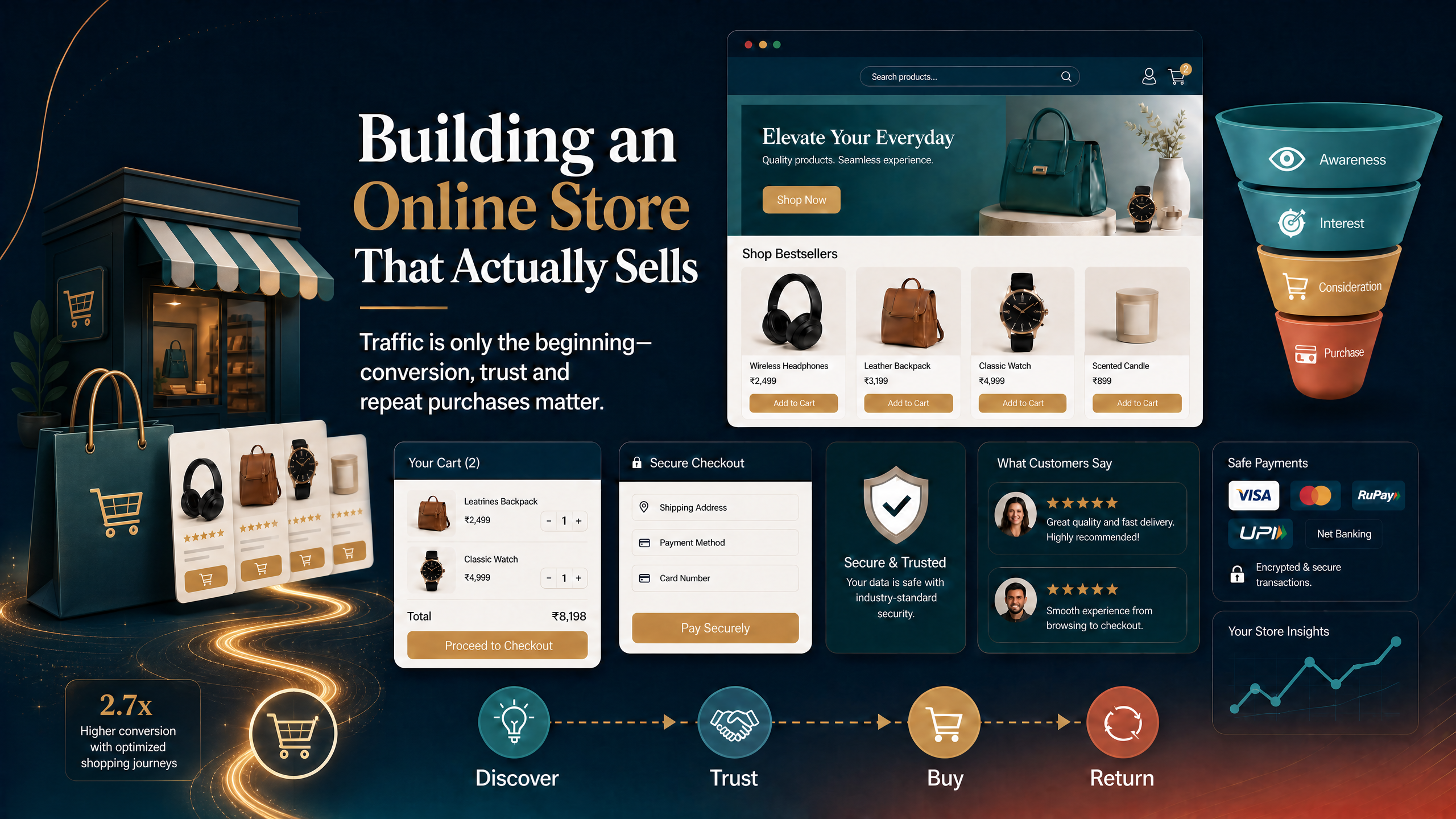
Plenty of online stores get built. Far fewer sell well. The gap is almost never the technology — it's decisions made before and after the build that nobody discussed.
Jayshree Technosoft LLP has been building e-commerce websites and web applications from Jaipur since 2009. This is what we've learned about what actually determines whether an online store works.
What an E-Commerce Project Really Includes
Businesses often think of an online store as a catalogue with a buy button. The working parts are more than that, and each one needs a decision:
Product catalogue — with variants (sizes, colours, materials), pricing rules, and images that load quickly on a phone.
Cart and checkout — the part where most sales are lost, and therefore the part worth the most attention.
Payments — UPI first for Indian customers, plus cards, net banking, and often cash on delivery.
Order management — where you see, process, and dispatch orders without spreadsheets.
Inventory — stock that reduces automatically so you don't sell what you don't have.
Shipping and tracking — courier integration, charges by weight or location, and customers who can check their own order status instead of calling you.
Customer communication — order confirmations, dispatch updates, and delivery notifications. In India, on WhatsApp, because that's where customers actually read messages.
The Three Places Online Stores Lose Money
1. Checkout friction
Every additional step between "I want this" and "payment done" costs sales. The common mistakes: forcing account creation before purchase, asking for information you don't need, hiding delivery charges until the final screen, and a form that's painful on a phone.
The fix is unglamorous: guest checkout, minimum required fields, delivery costs shown early, and UPI prominently placed. We spend more design effort on checkout than on any other screen, because that's where the money is decided.
2. Payment failures handled badly
Payments fail more often in India than most markets — networks drop, bank servers time out, UPI apps hang. What happens next decides whether you keep the sale.
A blank screen leaves the customer unsure whether they've been charged, and they don't come back. A clear message — "payment didn't go through, you have not been charged, try again or use another method" — with an easy retry keeps most of them.
This is invisible revenue loss. Nobody complains; they just leave.
3. Trust gaps
Indian online shoppers are cautious with unfamiliar stores, and reasonably so. What builds confidence: a visible phone number and address, clear return and refund policies, real product photos rather than stock images, honest delivery timelines, and customer reviews.
These cost nothing to include and are frequently missing.
Platform or Custom? An Honest Answer
Ready-made platforms (Shopify, WooCommerce and similar) are the right answer for most businesses starting out. They're faster, cheaper, and cover standard requirements well. If your business sells products in a standard way, use one — we'll tell you so.
Custom development earns its case when your requirements genuinely don't fit: complex pricing rules (customer-specific rates, bulk slabs, B2B pricing), deep integration with existing billing or inventory systems, unusual order workflows like made-to-order or quotation-based selling, or a scale where platform fees exceed what a build would cost.
A common middle path we implement: a platform for the storefront, integrated with the business's existing systems so orders, stock, and accounts stay connected.
The Part Businesses Forget: Getting Visitors
A common and expensive assumption is that launching a store produces customers. It doesn't. A store with no traffic sells nothing regardless of how well built it is.
Which means SEO considerations belong in the build, not after it: clean URLs, fast loading on mobile data, proper product page titles and descriptions, structured data so products appear correctly in search results, and image optimisation.
These are far cheaper to build in than to retrofit — and retrofitting is what most businesses end up paying for.
What We Look at Before Quoting
When a business approaches us about an online store, these determine the answer more than the number of products:
How complex is your pricing? Do you need integration with existing billing or inventory? How do orders flow through your business after payment — who packs, who dispatches, who updates the customer? Do you sell to consumers, businesses, or both? And what happens with returns?
Anyone quoting an e-commerce build without asking these is guessing, and you'll pay for the guess through change requests.
What We Do
Jayshree Technosoft LLP builds e-commerce websites and web applications for businesses across Jaipur, Rajasthan, and India — from straightforward product stores to custom platforms with B2B pricing, inventory integration, and connected order workflows. We also work with businesses whose store already exists and isn't converting, which is often a cheaper problem to fix than to rebuild.
Planning an online store, or wondering why the one you have isn't selling? Get in touch — we'll start by asking about your business, not by showing you templates.
Recent Articles

Best CRM Software in Jaipur for Kirana Stores: How POS Billing CRM Simplifies Daily Operations

How DataBridgeCRM's Real Estate CRM Works, From First Enquiry to Closed Deal

How LawDesk & CADesk Work for Lawyers and Chartered Accountants
