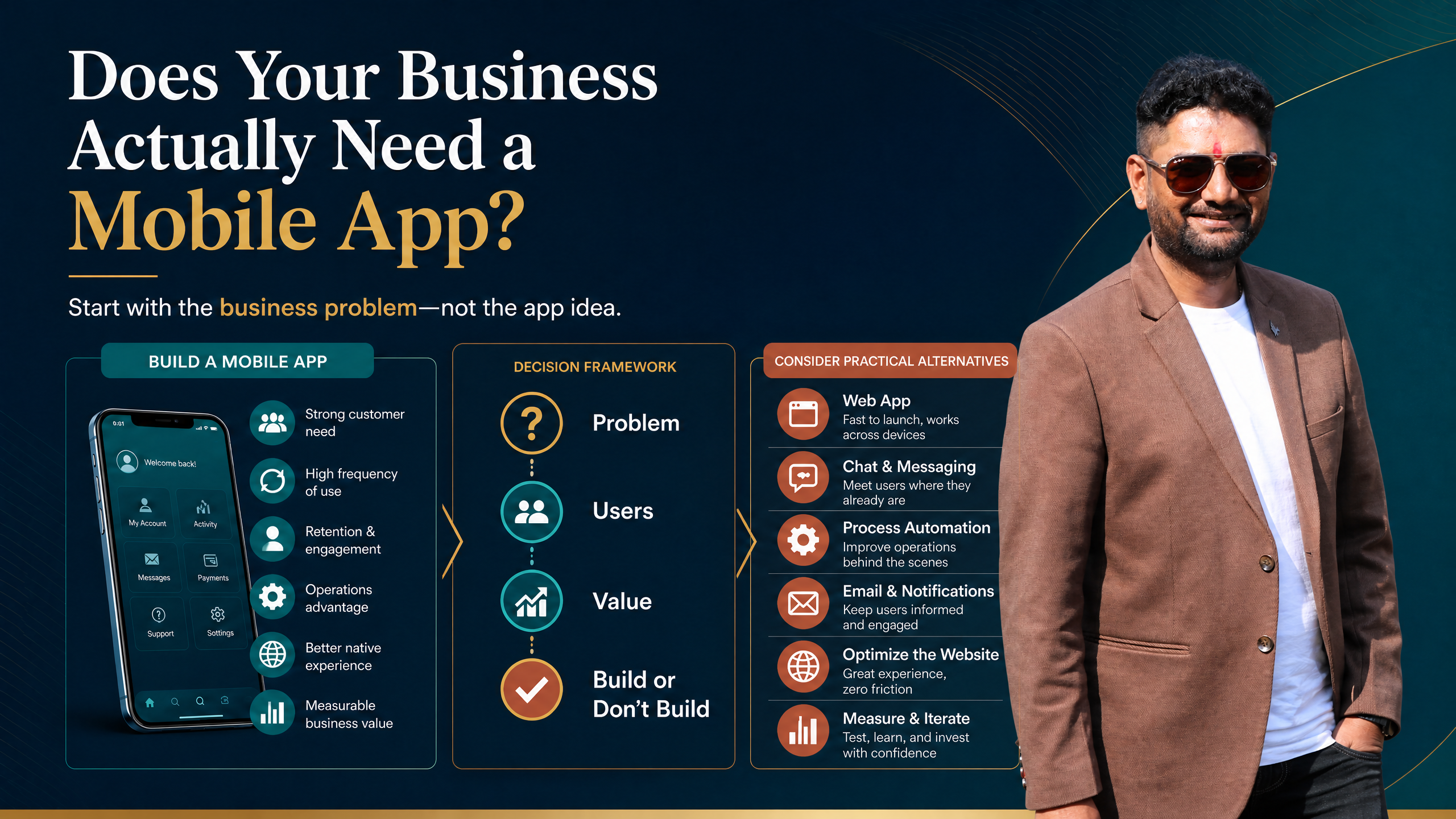
Every business owner has had this thought: we should have an app. Sometimes it's the right instinct. More often, what the business actually needs is a better mobile website — and the app becomes an expensive thing nobody downloads.
Jayshree Technosoft LLP has built Android and iOS applications since 2009, and we regularly tell clients not to build one. Here's how to tell which side you're on.
The Question That Settles It
Will your customers use this more than once a week?
That's the whole test, and it's uncomfortable because most businesses fail it honestly. People install apps for things they use constantly — messaging, payments, transport, food, banking. They do not install an app to buy from a shop twice a year, however good the app is.
An app requires a customer to search a store, download, install, and grant permissions before seeing any value. That's a significant barrier. A mobile website requires them to tap a link. The app must be worth more than that gap in friction, and infrequent-use apps rarely are.
When a Mobile App Genuinely Makes Sense
Daily or near-daily use. A delivery business, a service where customers track orders regularly, a subscription product they open constantly.
You need phone capabilities a browser can't reach well. Reliable push notifications, camera-based scanning, GPS tracking in the background, offline operation. If your core feature depends on these, an app is justified.
Your staff, not your customers. This is the case businesses overlook and it's often the strongest one. Field staff, delivery teams, sales people, technicians — internal apps have guaranteed adoption because people are paid to use them, and they solve real operational problems.
Offline is a requirement. Where connectivity is unreliable and work must continue regardless, apps handle this far better than websites.
When You Almost Certainly Don't Need One
Your website works badly on phones. Fix that first. It costs a fraction of an app and serves every visitor, not just those willing to install something. A surprising number of "we need an app" conversations end here.
You want an app because competitors have one. Check their download numbers and reviews before assuming it's working for them.
Customers interact with you occasionally. Annual services, infrequent purchases, seasonal businesses.
You want it for marketing reach. Getting people to install an app is harder and more expensive than reaching them where they already are — search, WhatsApp, social platforms.
The Cost Nobody Budgets For
Businesses budget for building an app. The ongoing commitments are what surprise them:
Two platforms, two sets of work if you need Android and iOS — though cross-platform frameworks now handle most business applications from a single codebase, which substantially reduces this.
App store requirements. Developer accounts carry recurring fees, submissions get reviewed, and both Apple and Google periodically change requirements that force updates whether you wanted them or not.
Operating system updates. Android and iOS update annually. Apps that aren't maintained break or get removed from stores.
Getting people to install it. This is the largest hidden cost and the one that kills most business apps. Building the app is the easy part; convincing people to download it is a marketing programme, not a launch announcement.
The Options Between "Nothing" and "Full App"
Most businesses that think they need an app are better served by something in between:
A properly built mobile website. Fast, works on every phone, nothing to install, findable on Google. For most customer-facing businesses this is the correct answer, and it's what we recommend most often.
Progressive web app. A website that can be added to the home screen, works offline to a degree, and can send notifications on supported platforms. It gets you part of the app experience without store distribution — a genuine middle path worth evaluating.
WhatsApp-based interaction. In India particularly, customers are already on WhatsApp daily. Order updates, reminders, and support through a channel they already use often beat an app they'd have to install.
An internal app only. Build for your staff where adoption is guaranteed, keep customers on the web.
If You Do Build One: Getting the Scope Right
The most common failure in business apps isn't technical — it's building too much. An app with twenty features that does none of them memorably performs worse than one that does a single thing exceptionally.
Identify the one action your users will take repeatedly. Make that action fast and obvious. Everything else is secondary, and much of it can stay on your website.
Also decide early: cross-platform or native? Cross-platform frameworks cover the large majority of business use cases from one codebase at significantly lower cost. Native is worth it for graphics-heavy applications, deep hardware integration, or where platform-specific polish is central to the product.
How to Decide This Month
Answer three questions honestly. How often will a typical user open this? Less than weekly means reconsider. What can an app do that a good mobile website can't? If you can't name something specific, you need a better website. Who will get people to install it, and how? If there's no answer, the app will launch to silence.
Thinking about a mobile app for your business? Get in touch — including for an honest "improve your website instead" if that's what your situation calls for. Those conversations save clients more money than any project we've delivered.
Recent Articles

Best CRM Software in Jaipur for Kirana Stores: How POS Billing CRM Simplifies Daily Operations

How DataBridgeCRM's Real Estate CRM Works, From First Enquiry to Closed Deal

How LawDesk & CADesk Work for Lawyers and Chartered Accountants
